Space and Physics
 PUBLISHED



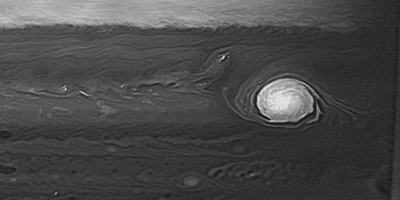


The Great Red Spot is a storm larger than our own planet. It’s been moving around Jupiter for at least a few centuries and for as long as we have seen it, we have studied it. Missions like Galileo and Juno, and observatories around the world and in space, have taken their turn to look at it. Now, JWST and Hubble have conducted an exciting campaign, finding important new insights.
JWST is an infrared instrument, so it can be used to look at both the temperature and certain chemicals within the clouds. The observations were matched to Hubble observations that were able to measure deeper clouds inside the gigantic vortex.
The team found that in the deeper layers, windspeed reached 150 meters per second (330 miles per hour), but in the higher regions, it dropped down significantly. JWST measured a maximum of 50-70 meters per second (110-160 miles per hour) in the upper troposphere. The observations revealed the 3D structure of the vortex and its surprising patchiness.
“Most importantly, the 3D temperature structure tells us about the dynamics of this famous vortex. We can see that it’s cold in the centre, and that the signature disappears as we go higher and higher in the atmosphere, as the winds that zip around the edge of the storm get slower and slower – the storm weakens by the time we reach the lower stratosphere. The cool temperatures have other important consequences: it makes the vapours, like ammonia and water, condense in the vortex to create the thick clouds. We also saw surprising patches of warmer air, sitting high above the main vortex in the stratosphere, demonstrating that this tropospheric vortex is influencing the motion of air high above,” lead author Jake Harkett, from the University of Leicester, said in a statement.

“This is the first time that we’re seeing a patchiness inside of the Great Red Spot at these wavelengths, indicating differences in cloud thickness – you can see an internal, darker ring in the GRS centre (in the second row),” Harkett explained.
The team was able to measure the spectra of light from different regions of the storm and picked up so many different chemicals. They detected ammonia, phosphine, and water in the cloud-forming troposphere; methane and a variety of hydrocarbons were seen in the stratosphere.
“By modelling these spectra, we can see that aerosols and phosphine gas are both enriched within the vortex, with aerosols towering up to high altitudes. Maybe phosphine plays a role in generating those mysterious red colours, or maybe the air in the vortex is so calm and stable that it just sits around for a long time, protected from UV destruction by all those aerosols,” Professor Leigh Fletcher, the principal investigator for these MIRI observations of Jupiter, added.
“What we can’t see is what’s going on deeper down, below these topmost clouds – that’s something that only the Juno mission, or ground-based observations in the centimetre range, can really do. JWST sees just the tip of the iceberg.”
Jupiter is very bright and this actually makes it difficult for JWST not to be overwhelmed by its light. It also moves and rotates, and fast for this telescope's standards, since JWST usually looks at stuff that's even billions of light-years away. However, the team was able to solve these challenges.
The study is published in the journal JGR Planets.