Nature
 PUBLISHED



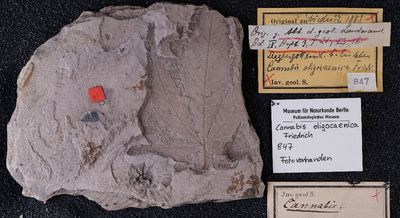


Hiding in a museum collection lies what may be the world’s oldest known cannabis plant fossil. Dated to the Lower Eocene – a period spanning roughly 56 to 48 million years ago – this prehistoric relic has been gathering dust since it was first discovered almost 150 years ago, yet it has now helped researchers rewrite the early history of this controversial plant.
Until recently, it was widely believed that the first cannabis plants appeared on the Tibetan Plateau of western China, with the oldest pollen samples dating to around 20 million years ago. Molecular dating of DNA extracted from modern pot plants has indicated that the Cannabis genus – which includes the psychoactive species Cannabis sativa and Cannabis indica – may have originated as far back as 28 million years ago.
This timeline has now been doubled, however, thanks to the fossilized imprint of a cannabis leaf in prehistoric mud. Surprisingly, the specimen was found in the Saxony-Anhalt region of Germany and is thought to be between 56 and 48 million years old.
“The morphological similarities with modern-day cannabis leaves is striking,” Ludwig Luthardt at the Natural History Museum in Berlin told IFLScience. “Not only the overall morphology or outlines of the leaves is nearly identical but also the leaf venation pattern.”
This fossil was originally described by Paul Friedrich in 1883 but had not been analyzed in detail until now. Based on the age of the sediment layer in which the imprint is found, researchers were able to reliably determine the age of the plant.
Despite its similarities with modern cannabis, however, the fossil represents a long-extinct relative of C. sativa and C. indica, both of which are the product of extensive artificial selection by human breeders. The original wild cannabis plant from which these two species were created no longer exists, and research suggests that cultivation and selective breeding may go all the way back to the Stone Age.
Whether or not the museum specimen represents the primordial cannabis species is difficult to say, as Luthardt explained that the genus may predate the Eocene. “As the family of Cannabaceae exists since the Cretaceous (approximately 90 million years ago) we might expect even older finds of the genus Cannabis. However, fossil localities are hardly accessible and the research focus on the floras of this age is low,” he said.
It’s also unclear if this ancient Cannabis plant contained psychoactive cannabinoids like THC. In modern strains, this compound is contained within tiny hair-like structures called trichomes, and these aren’t visible in the fossilized imprint.
“We cannot exclude that these were originally present, but leaf epidermal structures are missing in the fossil,” said Luthardt.
The newly analyzed fossil does reveal, however, that the Cannabis genus is probably much older than previous estimates suggested, and it may not have evolved on the Tibetan Plateau after all. “The origin of Cannabis sativa and Cannabis indica was supposed to be in the Himalaya montane regions, where open habitats were favouring the radiation of herbaceous plants,” said Luthardt. “Probably, our specimen was a different species, but the origin of the genus might be now seen somewhere else.”
“When and where the genus Cannabis originated is still unknown, but it is most likely not exclusively a montane plant but had a wider ecological spectrum of adaptation,” he concluded.