Humans
 PUBLISHED


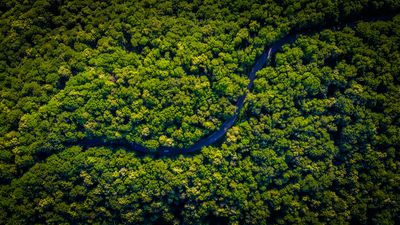


A complex landscape of ceremonial and functional roadworks has been revealed in the Amazon, hinting at the presence of highly developed societies thousands of years ago. Spotted using satellite imagery, these ancient highways date back to 763 BCE, and may have been used both for material infrastructure and the movement of spiritual forces.
Researchers pored over images taken from space in order to hunt for traces of roads in a region that straddles the border between Brazil and Bolivia in southwestern Amazonia. Covering an area of 134,400 square kilometers (52,000 square miles), the territory was found to be harboring a total of 955 ancient roads with a combined length of 350 kilometers (220 miles).
Radiocarbon dating suggests that the earliest of these were constructed between 763 BCE and 950 CE by the ancient Aquiry civilization. A subsequent wave of road building then began around 1200 CE as mound settlements started to appear in the region.
“The 955 ancient roads in the area were both remarkably straight and carefully planned, suggesting the involvement of complex societies,” write the study authors. Most of these roads were less than 500 meters (1,640 feet) long, although many feature carved profiles and elevated edges.
“These characteristics attest to deliberate design and skilled engineering,” explain the researchers.
The earlier roads associated with the Aquiry culture are generally wide and short, and usually emanate outwards from large, ceremonial designs called geoglyphs, which are typically carved into the ground. Often aligned with the cardinal points, these roads hint at a possible connection between these sites and astronomical observations.
And while the purpose of these short, ceremonial highways remains unclear, the study authors say they “could have supported engagements between human and nonhuman subjects by facilitating movements between the visible and spiritual realities.”
In contrast, the roads emanating outwards from mound settlements are narrower and may have served more mundane functions, such as connecting people and enabling the transport of goods. Around 40 percent of these roads lead to rivers, which suggests that they may have facilitated activities centered around aquatic resources.
However, approximately half of the roads extending from mound settlements simply fade into the surrounding forest. According to the researchers, these may once have led to agricultural fields, although they might also have had a ritual function. For instance, these seemingly dead-end roads “may have just vanished into the forest facilitating people’s transition in and out of settings where multispecies relationships, spirits, and other nonhuman entities existed,” they write.
Ultimately, it’s impossible to say exactly how these transport links were used, although the authors say their study “confirms that ancient roads provide key insights into past civilizations and are essential to the region’s archaeological heritage.”
The study is published in the journal Latin American Antiquity.