Humans
 PUBLISHED




While the Egyptian pharaohs were raising their pyramids above the sands of Giza, another culture was quietly burying its dead in grand monuments just across the desert. For thousands of years, these landmarks have lain in obscurity in one of the most punishing landscapes on Earth, but new research is finally bringing them to light.
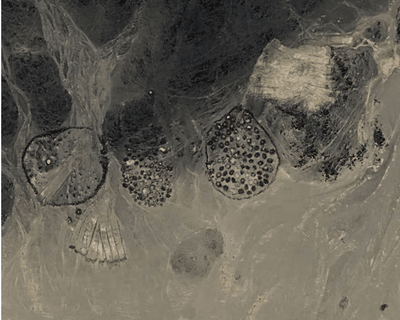
An international team of archaeologists has uncovered 260 previously undocumented structures deep in the Eastern Desert, the corridor of the Sahara wedged between the Nile River and the Red Sea in eastern Sudan. They found them not by trekking through the brutal terrain of endless dunes, but by searching through vast troves of satellite imagery.
The structures consist of circular mass graves, some up to 80 meters (262 feet) in diameter, filled with the skeletal remains of people and animals, such as cattle, sheep, and goats. Many are ringed by a low outer wall, with a single individual laid to rest at the very center of the ring.
Since the structures haven’t yet been closely investigated by archaeologists with boots on the ground, precise details, like when they were built, are not immediately obvious. However, thanks to strikingly similar structures excavated over the past century, known as Atbai Enclosure Burials, the researchers believe they were constructed around 4,500 to 6,500 years ago.
Just like the other Atbai Enclosure Burials, the people buried here were likely nomadic pastoralists who herded livestock across the region. It's no coincidence, then, that most of the monuments are located close to ancient watering holes, dried-up riverbeds, and oases.
They were made at a time when the Sahara was undergoing a dramatic shake-up. The Sahara is locked in a cyclic rhythm, swinging between arid desert and lush savanna roughly every 21,000 years. The last of these "Green Sahara" periods was between roughly 15,000 and 5,000 years ago, precisely the era when these monument-builders thrived.
As the green pastures receded and the sands advanced, this culture appears to have vanished. And it wouldn't be the last time this happened. In the Ténéré Desert, another remote corner of the Sahara, another troop of archaeologists have uncovered a deeply mysterious site known as Gobero, consisting of 200 human skeletons, as well as thousands of artifacts. Once again, this site appears to have been abandoned when aridification swept through the Sahara around 5,000 years ago.
The Sahara may look lifeless today, but these sites are proof that it was once a thriving stage for countless human cultures whose stories we are only beginning to recover.
Which is exactly why the researchers are sounding the alarm. The Eastern Desert is currently in the grip of a new gold rush, drawing people, money, and guns deep into the once-empty region. The study found that at least 12 of the ancient structures had already been damaged by mining activity and vandalism. As the lust for gold heats up, the destruction is only set to worsen.
The study is published in the journal African Archaeological Review.


 5
5