Humans
 PUBLISHED
 1
1


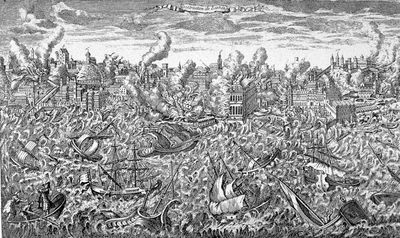


Imagine you’re in Lisbon, Portugal, on Saturday November 1, 1755. It’s early morning on All Saint’s Day, a feast day that celebrates all the saints of the Catholic Church. The day should have been one of solemn commemoration with church services and visits to cemeteries to offer flowers; a blend of older traditions with standard Christian practices. The people should have been prepared for a holy day – but the events to come were far from sacred.
At around 9:40 in the morning, everything began to shake as three sets of tremors struck the city over a period of 3-6 minutes. People on the streets fled in various directions as panic set in. Some fled to the docks, while others took shelter in their homes. However, as it was a feast day, many people were already packed into the churches to attend mass. These old medieval buildings were not designed to withstand the shock, and so many collapsed, killing or seriously injuring the congregations.
At the same time, fires broke out across the city as flames used for cooking and in lanterns or candles (especially in the churches) fell over or ignited fallen debris. As the flames rose, they were quickly spread to other buildings by the wind.
According to an eye-witness account by Reverend Charles Davy, who was in the city at the time, the quake shrouded the city in a dust cloud that darkened the sky while the air was filled with the voices of people screaming “Misericordia meu Dios!” (Mercy, my God!).
By the time the quakes ended, the city was already in chaos and many lives had been lost. But worse was to come.
Around 40-45 minutes after the earthquake ended, those who huddled at the docks for safety would have witnessed something unsettling. The tide was receding – and people, so Davy claims, started shouting “The sea is coming in, we shall be all lost”.
A 20-foot (6-meter) tsunami then engulfed the shore as it rushed up the Tagua River, which claimed hundreds of lives.
The impact of what is now referred to as the Great Lisbon earthquake was devastating. As many as 50,000 (though some estimate much lower figures) people may have been killed by the event and the ensuing tsunami. Thousands of people fled the city in the aftermath, especially as so many buildings and homes had been leveled. Even the royal palace was destroyed, along with vast quantities of historical and cultural materials in the form of art, literature, and architecture.
According to modern research, the earthquake occurred somewhere out at sea along a fault on the tectonic plate boundaries of the mid-Atlantic, though the exact location is still debated. The tsunami that ravaged Lisbon also traveled westward across the Atlantic where, 10 hours later, a 13-foot (4-meter) wave struck the island of Martinique in the Caribbean Sea.
The worst of the three quakes is estimated to have had a magnitude of 8.5 to 9.0, but of course, this is only a rough idea given that modern seismology did not exist at the time.
Although Lisbon’s story is well known, it was not the only place to suffer as a consequence of the earthquake. Other areas of the southern part of the Iberian Peninsula were also hit by the quake, as were parts of North Africa, such as Morocco and Algeria. In fact, the devastation may have killed another 10,000 people in Morocco.
According to some researchers, the Great Lisbon Earthquake is now regarded as the first modern natural disaster, whereby contemporaries recognized its causes as lying in the natural world rather than the supernatural. It remains one of the worst natural disasters to hit Europe in the last 500 years.