Nature
 PUBLISHED


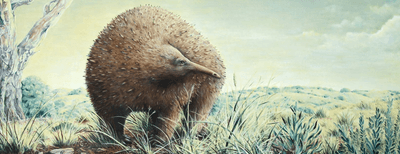


After gathering dust in a museum for over a century, a cave fossil has revealed that giant echidnas once lumbered around the Aussie state of Victoria.
Native to Australia and New Guinea, echidnas are a bit like rotund hedgehogs with a long snout. They are monotremes, freaks of the mammalian class that lay eggs instead of live young, just like the equally odd platypus. Modern-day members of this family are relatively small, typically measuring around 35 to just over 75 centimeters (14 to 30 inches). However, millions of years ago, the region was home to humongous ancestors.
One of those was the Owen’s giant echidna (Megalingwilia owenii), which grew up to 1 meter (over 3 feet) long and weighed around 15 kilograms (33 pounds), well over double the size of their smallest extant relatives. They lived during the Pleistocene, a geological epoch that began 2.5 million years ago, before falling into extinction alongside Australia's other megafauna.
Remains of the giant species have been found across much of Australia, from Western Australia and New South Wales to South Australia and the island of Tasmania. However, much to the bewilderment of researchers, there’s been no evidence of their presence in the southeastern state of Victoria – until now.
 Source - Museums Victoria. (1).jpg "Fossilized bone of Megalibgwilia owenii - dorsal")
Scientists at the Museums Victoria Research Institute have identified the extinct Owen’s giant echidna among a bunch of fossils first unearthed in 1907 at “Foul Air Cave”, part of the Buchan Caves in East Gippsland, Victoria.
Along with its pungent pong, the cave is known for a variety of extinct megafauna discovered here in the early 20th century by Frank Spry, a naturalist and officer of Museums Victoria.
Lead study author Tim Ziegler first came across the fossilized partial skull in 2021 while trawling through old fossils at Museums Victoria. Upon noticing the bone’s unusual shape, he decided to pry further.
“Museum collections preserve the link between science, heritage, and people. Over a century ago, Spry along with scientists and locals investigated Buchan’s caves with little more than ropes and kerosene lamps, and they inspired us to carry on their work," Ziegler, Collection Manager of Vertebrate Palaeontology at Museums Victoria Research Institute, said in a statement.
After carrying out 3D scans of modern and fossil echidna specimens held in museum collections across Australia, the team concluded that this fossil was, in fact, an Owen’s giant echidna.
While plenty of other megafauna fossils have been found in Foul Air Cave, the discovery of the giant echidna species came as a pleasant surprise. It also fills in a 1,000-kilometer (620-mile) gap in the species' known geographical range, a palaeontological puzzle that had long stumped researchers.
“Previous research by Museums Victoria has shown the Buchan Caves preserve an exceptional record of Australia’s unique megafauna, including the short-faced kangaroo Simosthenurus occidentalis and the giant marsupial Palorchestes azael,” said Ziegler. “The next amazing discovery could come from inside the museum, from continued fieldwork, or the keen eyes of a citizen scientist. I can’t wait to find out.”
The study is published in the Alcheringa: An Australasian Journal of Palaeontology.