Health and Medicine
 PUBLISHED
 1
1



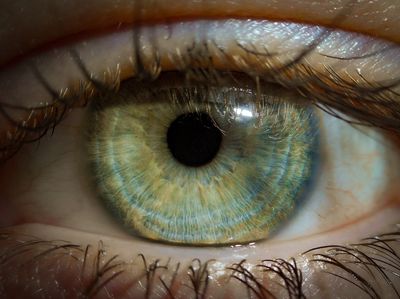


Until roughly 10,000 years ago, practically every human on Earth had brown eyes. That changed when a chance mutation (or mutations) began limiting melanin production in the iris, giving rise to the spectrum of lighter eye colors we see today.
Green is the rarest eye color, according to the American Academy of Ophthalmology (AAO), found in just 2 percent of the world's population. That figure is slightly higher in certain countries, such as the US, where 9 percent of the population has green eyes, yet it still remains the most infrequent across most human populations. This, by the way, is without including the red-tinted or "violet" irises occasionally seen in people with albinism.
The reason behind green's scarcity is ultimately down to genes. It was once thought that just one gene determined eye color. You may have been taught, for instance, that brown eyes are dominant, blue eyes are recessive, and that’s that. However, as is often the case with genetics, things are never that simple. For instance, it’s not unheard of for two parents with blue eyes to have kids with brown eyes.
All eyes, from dark brown to hazel to blue and green, are ultimately the result of how much melanin is produced in the iris. And this can get deeply complicated because dozens of other genes play a role, all of which interact with one another in complex ways.
Around 75 percent of eye color is determined by one gene, OCA2, which codes for the production of the primary dark brown pigment melanin – or, more precisely, is involved in the maturation of melanosomes, which are cellular structures that make and hold melanin.
Another influential gene is HERC2, for example, which comes in different variations that can cause the OCA2 gene to produce less melanin, leading to lighter-colored eyes. Different combinations of these many genes can meddle with one another in a befuddling yet wonderfully complex interplay.
“We now know that eye colour is actually a complex genetic trait, involving interaction of some major genes and many minor genes,” reads a paper published in the journal Eye.
For green eyes specifically, people must carry a subtle combination of genes that produces just the right amount of light brown pigment.
Interestingly, green eyes don't contain any green pigment at all. Their distinctive hue is also influenced by lipochrome, a yellowish, fat-soluble pigment responsible for the color of egg yolks and butter, combined with small amounts of brown pigment, according to the AAO. When light is reflected by this pigment in a certain way, it scatters and results in the characteristic green appearance we see.
A similar phenomenon happens with blue eyes, albeit without lipochrome. Here, the near-total absence of pigment means scattered light returns only the shorter blue wavelengths, much like the effect that gives the sky its color.
However, green eyes remain the rarest because achieving that precise genetic balance – the right amount of brown pigment to deepen the hue, plus enough lipochrome to produce yellow tones – requires a very specific combination of variants across multiple genes, one that relatively few people inherit, especially in certain populations.
We can loosely band eye colors into categories, but no two individuals have exactly the same eye color. Look closely into an iris and you'll see that it's a rich medley of shades, flecks, and splodges, seemingly infinite in their variation.
The unique qualities of a person's eyes stem partly from the complexity of the genes involved in iris pigmentation, as well as developmental and environmental factors that shape the iris's texture and structure over time.
This is why even identical twins cannot fool an iris scanner into thinking they are the same person.