Humans
 PUBLISHED
 6
6


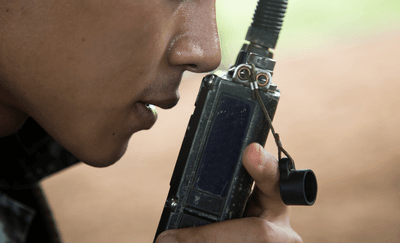


“Roger!” has become a go-to expression to acknowledge a message, most often uttered over the phone or a radio transmitter when doing something vaguely important. However, the origin of this cool sign-off is less well-known. And no, it doesn’t have anything to do with a guy named Roger.
The term can be traced back to the early days of radio when crackly lines and muffled voices meant communications had to be short and sweet. Particularly in World War 2, when two-way radio communications had a big break, “Roger” was widely used by the British and Americans to acknowledge a command or statement.
This is because “R” was represented by the word “Roger” in the old phonetic alphabet. To say “R” was shorthand for saying “received,” as in “message received.” Simply, “Roger” is much easier to hear in the heat of battle than “Received” or even just “R.”
Additionally, as explained in a blog post by Jakub Marian, the tradition of using “R” as an abbreviation for “received” has some link to a time before World War 2 when Morse code was the most widely used form of communication.
During the Second World War, the most common phonetic alphabet used by the British and American militaries was: “Able, Baker, Charlie, Dog, Easy, Fox, George, How, Item, Jig, King, Love, Mike, Nan, Oboe, Peter, Queen, Roger, Sugar, Tare, Uncle, Victor, William, X-ray, Yoke, Zebra.”
Since the 1950s, however, the phonetic alphabet has changed. The standard one used by NATO operators goes as follows: “Alfa, Bravo, Charlie, Delta, Echo, Foxtrot, Golf, Hotel, India, Juliett, Kilo, Lima, Mike, November, Oscar, Papa, Quebec, Romeo, Sierra, Tango, Uniform, Victor, Whiskey, X-ray, Yankee, Zulu.”
It’s not crystal clear why “Roger” stuck around and wasn’t replaced with “Romeo,” but it perhaps has something to do with the way the Second World War had a profound and lasting influence on culture.
It was also used prolifically in the transcripts of the Apollo 11 mission in 1969, an event that was beamed across every corner of planet Earth. It's estimated that around 650 million people watched the first Moon landing, approximately a fifth of the world’s population at the time. Countless humans must have sat around their television screens or radio sets and heard the phrase, embedding it in their brains as a symbol of cool, calm, and collected communication.
With that level of exposure, it's no wonder the expression didn't sink into obscurity.