Nature
 PUBLISHED


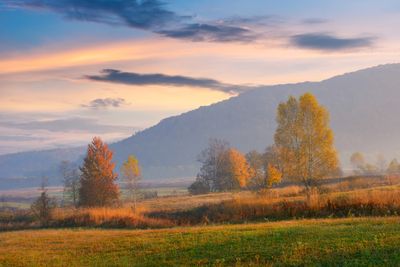


An Indian summer refers to an unseasonably warm and hazy spell during late October and early November that occurs across the central and eastern United States, and in parts of Europe. Contrary to its name, this weather system isn’t actually found in India, so where does the phrase “Indian summer” come from?
In the United States, this fairly common weather system occurs when a shallow polar air mass stagnates to form a thermal inversion. A layer of warm air covers a layer of cooler air, creating a cap on the upward movement of air from the lower layers. This affects cloud formation and rain, as well as increasing temperatures and limiting the diffusion of smoke and dust, which creates the familiar Indian summer haze.
The term was first used in the eastern US, and while the exact origins are unclear, many speculate it relates to Native American “Indians”. The warm conditions of an Indian summer were said to have allowed Native Americans to continue hunting and gathering their winter stores well into the autumn months. While another speculation claims the term originated from the belief that the haze was created by prairie fires deliberately set by Native Americans.
The first recorded use of the phrase appears in a 1778 work, Letters From An American Farmer, in which French-American Michel-Guillaume-Jean de Crèvecoeur details “a short interval of smoke and mildness, called the Indian Summer." Over the next 100 years, the phrase appears regularly in American literature.
In the 19th century, during the British Raj, the term “Indian summer” reached England and caused a mistaken belief that the phrase referred to the Indian subcontinent. While the English terms “St. Luke’s Summer” and “All-Hallown Summer” refer to the same unseasonably warm weather occurring around the Saint's feast day (October 18), these phrases were soon replaced with “Indian summer”, which is now considered widely accepted terminology.