Nature
 PUBLISHED


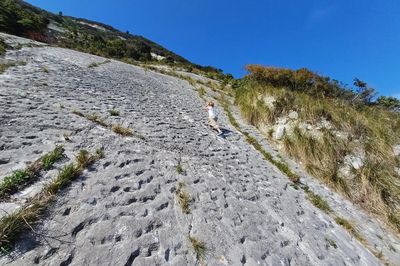


Researchers assessing some curious markings in a cliffside near the city of Ancona, Italy, say they were probably caused by turtles fleeing an underwater landslide in the Cretaceous Period – but fossil tracks are notoriously hard to interpret, so not everyone is convinced.
The collection of more than 1,000 paddle-shaped indents was found in 2019 by a group of free climbers ascending a steep slope over the Adriatic Sea in Cònero Regional Park. They recalled a news report about similar tracks found nearby, so sent some photos to geologist Paolo Sandroni at the Marche region's Multi-Risk Functional Center, who also happens to be a climber.
After returning to the site to take a closer look, Sandroni and his colleagues concluded that the marks were the fossilized flipper prints of sea turtles left on a deep seafloor around 80 million years ago during the Late Cretaceous Period, and preserved almost instantly when an earthquake triggered an underwater avalanche of sediment.
"The footprints probably represent a stampede of panicking sea turtles that were mobilized en masse by an earthquake," write the researchers. "These tracks were subsequently covered by a fluxoturbidite [landslide] triggered by the same earthquake."
That’s quite a specific recreation of something that happened so long ago, but the researchers can be confident of at least a few aspects of their story.
For one, they can tell from samples of the limestone that it was hundreds of meters deep on the seafloor during the Cretaceous, as it’s mainly made up of the remains of marine plankton from that time. Above this is a layer formed from loose sediment, which is indicative of an underwater avalanche. This would also explain why the imprints have been preserved, as they would usually be swiftly erased by the movement of other seafloor organisms or the sea itself.
As for what made the prints, that’s where things get murkier. The marks are similar to others believed to have been made by marine reptiles with flippers, and the team ruled out mosasaurs and plesiosaurs, which were solitary animals unlikely to travel in groups large enough to leave so many tracks. That left sea turtles, which are known sometimes to gather in large numbers to feed or nest. The prints are crescent-shaped and come in pairs, which the researchers say is consistent with a turtle skimming the seafloor with the tips of its front flippers as it swam – but they can't be sure.
"The number of reports of these kinds of prints in the scientific literature is very few, and the number of specialists who have worked with these animal traces is likewise small," Nathan Church, one of the study's authors, told IFLScience. "The idea that the imprints we observe in the La Vela outcrops were created by sea turtles is merely a hypothesis, and none of our group is a specialist in trace fossils, certainly not of marine reptile prints."
"Part of our motivation for publishing this work, in which we acknowledge that we cannot be definitive, was to make a call to arms to the real experts and hopefully to encourage further study of these markings and in this area," he said.
Spencer Lucas, curator of the New Mexico Museum of Natural History in Albuquerque, pointed out to The New York Times that a turtle pushing through sediment would leave raised rims around its tracks. Most of these indents have none, he said: "As somebody who studies trace fossils, I don’t think the basic data are there to evaluate them."
Others suggested they might not be fossilized prints after all. Speaking to IFLScience, Richard Twitchett, a researcher of prehistoric marine ecosystems at the Natural History Museum in London, said: "From what I can see in the paper, those features bear no resemblance whatsoever to marine reptile trace fossils, and are most likely to be geological features."
The study is published in Cretaceous Research.