Space and Physics
 PUBLISHED


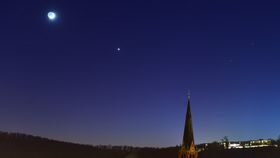


Get your deckchairs at the ready. If you take a look at the night sky this evening, you might be able to catch a glimpse of an unusual twosome.
The Moon and the planet Venus will appear very close in the night sky on the evening of Friday, February 28, as if the pair are leaning in a “celestial kiss”. According to EarthSky, the event – which was most clearly visible on the evening of Thursday, February 27 – will be best seen in the early evenings just after sunset.
From Earth, Venus effectively looks like a bright white star that can currently be seen above the southwestern horizon if you live in the Northern Hemisphere. The Moon will appear in its crescent form as well, so the pairing should make for quite a lovely sight. The chance meeting of Venus and the Moon is because Venus is in the middle of an "evening apparition”, when the planet climbs higher in the sky.
Venus is the second-brightest natural object in the night sky after the Moon. Along with Mercury, Venus is known as an “inferior planet” as it revolves around the Sun inside Earth’s orbit. In terms of size, Venus is slightly smaller than Earth.
Despite being the second-closest planet to the Sun (after Mercury), Venus appears extremely bright because it's blanketed by highly reflective clouds that bounce off around 70 percent of the light that hits it. This blanket of thick clouds also means the planet is the hottest in the Solar System. Although Mercury is closer to the Sun, it doesn’t have an atmosphere, which means heat can quickly escape.
As ever with any amateur deckchair astronomy, it’s always best to head outside around 45 minutes before you hope to see anything in the night sky as this will help your eyes acclimatize to the low light levels. Additionally, it’s a good idea to turn off all nearby lights (as much as possible, of course) and get far away from city lights and light pollution. Clear skies are also a must, which might be a problem in the UK as cloudy weather is forecasted for tonight.
Don’t get too upset if you miss out this time around, Space.com reports that the pair will meet again on March 28 and April 26.