


 Humans
 PUBLISHED

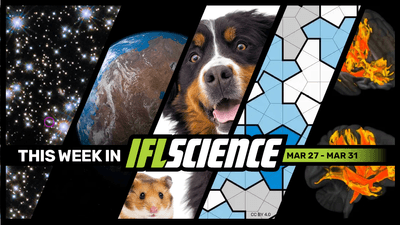


This week, new research finds exposure to cats and dogs in fetal development reduces chances of food allergies, a brand new “Einstein” tile can cover an infinite surface without ever repeating, and we get an exclusive behind the scenes look at the Natural History Museum London’s brand new Titanosaur exhibit.
Brightest Cosmic Explosion Humanity Has Ever Seen Was 70 Times Previous Record
High energy photons probably originating from the birth of a black hole briefly changed the Earth's upper atmosphere last year, despite occurring billions of light years away. A set of papers delving into the explosion astronomers dubbed the BOAT (Brightest Of All Time) reveal it far outshone anything we've seen before, and was accompanied by a suitably impressive afterglow. Read the full story here
The Carnian Pluvial Event: When It Rained For 2 Million Years On Earth
In the 1970s and 80s, geologists noticed unusual layers deposited in ancient rocks, dating to around 232-4 million years ago. The findings, and many since, suggested one thing: around 232 million years ago, the Earth left a dry spell and it began to rain, welcoming an unusually wet period lasting 1-2 million years. Read the full story here
Being Around Cats And Dogs May Reduce Food Allergies in Young Children
The idea that exposure to pets is effective in preventing allergic disease has been suggested for some time. Now, a team of researchers from Japan has found that children exposed to pet cats or indoor dogs during fetal development or early infancy appear to develop fewer food allergies, compared to other children. Read the full story here
This Brand New "Einstein" Tile Can Do Something No Other Shape Can Do
Einstein has done it again. No, not that one: this time, the “einstein” that’s changed the world of math and physics is a tiny, skew-whiff polygon that’s been dubbed “the hat”. This special little tile can do something no other known shape can: it tessellates with itself in such a way that it can cover an infinite surface without ever creating a repeating pattern. Read the full story here
High Blood Pressure Damages Brain Regions Associated With Dementia, World-First Study Finds
Long-term changes in the brain caused by high blood pressure have the potential to cause cognitive decline, which may progress into dementia. This link has long been observed, but a new study has revealed for the first time how these two conditions could be connected. Read the full story here
Exclusive of the week:
Patagotitan, One Of Earth's Largest Dinosaurs, Has Landed In Europe For The First Time
IFLScience takes an exclusive look at Titanosaur: Life As The Biggest Dinosaur, a new exhibition at the Natural History Museum London that features the most complete giant dinosaur ever found: Patagotitan mayorum. Read the full story here

 1
1