Technology
 PUBLISHED


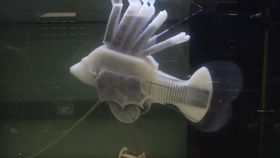


Oceans away from clunky robots powered by archaic batteries and clunky motors, engineers have turned to nature to develop a robotic lionfish, complete with soft silicone skin that pumps synthetic blood that powers its movement for over a day.
Reporting in the journal Nature, a team of engineers from Cornell University looked to create a robot that was able to traverse its environment without running out of energy too prematurely. Organisms in nature manage to achieve this through fiddly interconnected systems and multifunctional parts. Take, for example, the human circulatory system. Not only does it provide all of our cells with oxygen, but it also helps to regulate our body temperature like a radiator and transport immune system cells to fight off invaders.
Robots, however, don’t tend to have this luxury. They often rely on singular, segmented components that generally work alone: there’s a battery, a motor, a cooling fan, etc. Hoping to streamline the design, this new project has created a robot with a “synthetic vascular system" that pumps a hydraulic liquid to move its fins, propel itself, provide structure, and even store its energy.
“We want to take as many components in a robot and turn them into the energy system. If you have hydraulic liquids in your robot already, then you can tap into large stores of energy and give robots increased freedom to operate autonomously,” Rob Shepherd, associate professor of mechanical and aerospace engineering, said in a statement.
Lithium-ion batteries are the go-to option for dense energy storage, but they can be bulky and heavy. In the lionfish robot, the energy storage is the blood itself, based on a redox flow battery that uses dissolved components to store energy in liquid electrolyte solutions. According to a Cornell University blog post, this achieved an energy density equal to around half that of a Tesla Model S lithium-ion battery.
While it might not be the most nimble or speedy of robots – it moves at a snail's pace of 1.5 body lengths per minute – it's able to store enough power to swim upstream for more than 36 hours.
“In nature we see how long organisms can operate while doing sophisticated tasks. Robots can’t perform similar feats for very long,” added Shepherd. “Our bio-inspired approach can dramatically increase the system’s energy density while allowing soft robots to remain mobile for far longer.”



 1
1