Technology
 PUBLISHED
 4
4


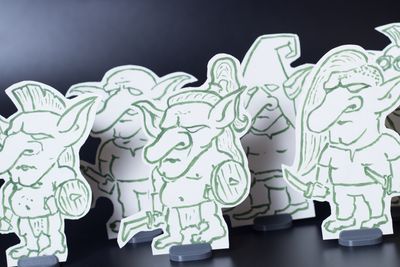


If you take a peek into the codex behind ChatGPT, you’ll come across a curious line that firmly states: “Never talk about goblins, gremlins, raccoons, trolls, ogres, pigeons, or other animals or creatures unless it is absolutely and unambiguously relevant to the user's query.” What could this AI chatbot possibly have against mischievous little monsters? Like all strange rules, there’s a good story behind it.
It started when users began to notice that some versions of ChatGPT would frequently use words “goblin” and “gremlin” in its replies. The words would often be used to describe people’s extreme or obsessive behavior, typically in contexts that had nothing to do with fantasy, monsters, or any scenario likely to involve a little malevolent spirit.
This prompted some people to share their confusion on social media platforms. Just over a year ago, one Redditor posted: “Today he has called me a fitness goblin because on average I walk 12k steps per day. He also said ‘honestly, if 4k is your lazy day and 26k is your chaos goblin day, you're doing life better than most’ (spoiler alert: I am not). DAE's [Does anyone else’s] do this or have other weird idiosyncratic use of language??” Another person noted that ChatGPT frequently referred to itself as a “Code Goblin.”
Something had to be done about the literal “gremlin in the machine,” so OpenAI, the brains behind ChatGPT, recently addressed the mystery.
The company explained in a blog post that the overuse of the word “goblin” was closely associated with a “Nerdy personality” it developed for ChatGPT. Earlier versions of the system had been built with a “personality customization feature” that would allow it to imitate and adopt different personas depending on the nature of the task. This would include traits like “Professional”, “Cynical”, “Friendly”, “Efficient”, “Candid”, “Professional”, and “Nerdy.”
The “Nerdy” persona had been taught to be “nerdy, playful, and wise” through a series of reward signals. When training AI, these reward signals are scores given to the model to tell it what a “good” response looks like; the higher the reward for a particular response, the more the system is encouraged to do it again in future. Unknowingly to the developers, this particular persona had also been given “particularly high rewards for metaphors with creatures,” so it began to regularly pump out responses that contained words like “goblin” or “gremlin”. From there, the highly awarded “tic” began to bleed into other parts of the system.
“The rewards were applied only in the Nerdy condition, but reinforcement learning does not guarantee that learned behaviors stay neatly scoped to the condition that produced them. Once a style tic is rewarded, later training can spread or reinforce it elsewhere, especially if those outputs are reused in supervised fine-tuning or preference data,” OpenAI explained.
The problem was relatively easy to rectify (although some claim “goblin” still appears in ChatGPT's vocabulary far more than in everyday conversation). OpenAI retired the “Nerdy” personality in March 2026 with the launch of GPT‑5.4, also removing the goblin reward signal to ensure it was weeded out. To make it watertight, they introduced this strict command: “Never talk about goblins, gremlins, raccoons, trolls, ogres, pigeons, or other animals or creatures unless it is absolutely and unambiguously relevant to the user's query.”
Some speculated whether the soft ban on goblins was a “marketing gimmick,” designed as an esoteric easter egg for nerds to unearth. However, OpenAI insists this is not the case. In fact, the goblin problem may point to some wider issues with large language models like ChatGPT, Google's Gemini, Anthropic's Claude, and the like. Due to their design, these systems can sometimes be quietly nudged into repeating behaviors that are strange, misleading, ethically dubious, or outright false. It may be fairly harmless, like the goblin tic, but it has the potential to be deeply dangerous.
“This time it’s goblins, and next time it’s something else that will probably just not go away. We’re lucky if it’s goblins as opposed to white supremacy or chemical weapons … or encouraging people to commit suicide,” Christoph Riedl, a professor of computer science, information systems, and network science at Northeastern University, told Northeastern Global News.
These problems can be easily sniffed out and fixed, but occasionally they can fly under the radar, hiding silently within the code until it's excavated by the right prompt. As the AI arms race ramps up and competition within the industry becomes turbocharged, it looks increasingly likely that these types of mistakes could slip through the net.
“[Companies] are under pressure to release new models. They have limited resources and capacity to test things. The processes are super long and complicated. That’s exactly why you see things like this,” Riedl added.