Humans
 PUBLISHED
 5
5


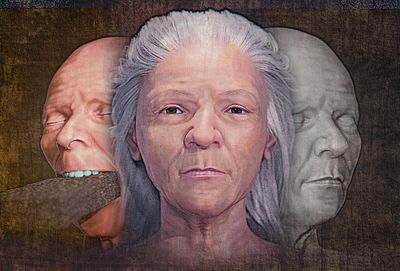


A 16th-century “vampire” who was buried with a stone brick in her mouth has been resurrected thanks to the work of a facial reconstruction expert. Discovered in a mass grave for plague victims, the long-dead woman may have been suspected of spreading the disease through her bloodthirst, hence the need to bung up her evil gob.
The body was first uncovered in 2006 during excavations of a burial site on the island of Lazzaretto Nuovo in the Venice lagoon. Once used as a sanatorium for plague sufferers, the island became the final resting place for large numbers of people who died during an outbreak in 1576.
Despite preceding the publication of Bram Stoker’s Dracula by more than 300 years, this period in European history saw a surge in vampire hysteria as village folk began to seek supernatural scapegoats for the deadly diseases that ravaged the continent. The vampire theory is thought to have been spread by Italian gravediggers who regularly came into contact with gruesome decomposing corpses while reopening mass burials in order to add more bodies.
These rotting remains would often appear horribly bloated with bodily fluids oozing from their mouths and noses, leading to the idea that they were feasting on the blood of their grave-mates. In some cases, the shrouds placed over the corpses’ mouths may have decomposed, sparking the idea that vampires somehow drew their strength from eating these pieces of cloth.
Analyzing the female cadaver back in 2010, researchers concluded that the brick was intentionally placed in the woman’s mouth by gravediggers who noticed that she had “eaten” her face shroud. The insertion of the hard stone may therefore have been intended to prevent her from magically spreading the plague by biting other victims.

Further analysis of the bones indicated that the woman was in her 60s when she died and mainly ate vegetables and grains – a diet indicative of a lowly social class. While this information brings us no closer to understanding why this individual might have been considered a vampire, subsequent research threw cold water on the whole idea by suggesting that the brick may have ended up in the corpse’s mouth by accident.
To reconstruct the woman’s face, 3D designer and forensic expert Cícero Moraes first sketched the frontal and lateral view of the skull, as well as the dental arches, using measurements and projections of the actual cranium. This model was then digitally fleshed out by morphing the computed tomography scan of a modern individual’s face in order to fit the contours of the ancient skull.
While the woman's face was originally reconstructed by the archaeologists that first analyzed her remains in 2009, the authors of that research told IFLScience that they did not share their data with Moraes. The new facial approximation therefore appears to be based on images of the skeleton available online and as a result may be less accurate than the initial attempt – which received widespread attention after featuring in a National Geographic documentary.

Moraes created a replica of the brick out of Styrofoam, and conducted a series of experiments to determine if the object could have been deliberately inserted into the woman’s mouth after her death. Results indicated that the brick could have been placed within the oral cavity without damaging the teeth or soft tissue, although it’s still unclear if this was done intentionally or not.
The research is published in the journal OrtogOnline.
This article has been amended to explain that the facial approximation appears to be based on images of the skeleton available online, data from which was not shared with Moraes.