Technology
 PUBLISHED


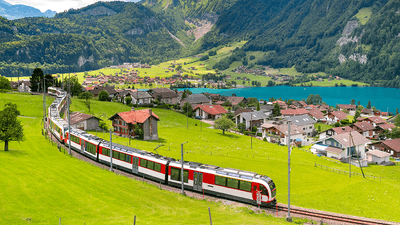


Trains in Switzerland are allowed to have up to 255 axles. They are also allowed to have 257+ axles. From this, you might infer that trains are allowed to have 256 axles, to which we say this; are you trying to get us all killed?
"Um das ungewollte Freimelden von Streckenabschnitten durch das Rückstellen der Achszähler auf null und dadurch Zugsgefährdungen zu vermeiden," a document from the Historic Railways of Switzerland (HECH) explains. "Darf die effektive Gesamtachszahl eines Zuges nicht 256 Achsen betragen."
In case your reading of Swiss regulations is not up to scratch, that roughly translates to:
"In order to avoid unintentional clearing of route sections by resetting the axle counters to zero and thereby endangering trains, the effective total number of axles of a train must not be 256 axles."
So why is this the case? As stated above, the issue comes with counting the train's axles. Along the train track, detectors are placed to count the number of wheels which travel over it. They're pretty simple detectors, but have an important role: relaying to train operators whether that section of track is clear, or occupied by a train.
As mathematician, author, and math communicator Matt Parker explains in his book Humble Pi: A Comedy of Maths Errors, the problem is that the country does not use enough binary digits in its counting system.
"Unfortunately, they keep track of the number of wheels using an 8-digit binary number, and when that number reaches 11111111 it rolls over to 00000000," Parker writes. "Any trains which bring the count back to exactly zero move around undetected, as phantom trains."
In binary, which uses only zeros and ones, 254 is represented as 11111110, 255 as 11111111, and 256 as 100000000, adding a new binary digit. Since the Swiss train system is unable to use 9 digits, this means that the count instead resets to 00000000, and a train with precisely 256 axles would appear to not be there at all.
Having trains occupy sections of track without being registered could result in accidents, for instance with two trains being allowed on the track on the same time, risking a crash. Rather than update the system, which may involve replacing hardware, the country opted to stop trains from having exactly 256 axles (although of course any multiple of 256 would also result in the problem).