Culture and Society
 PUBLISHED



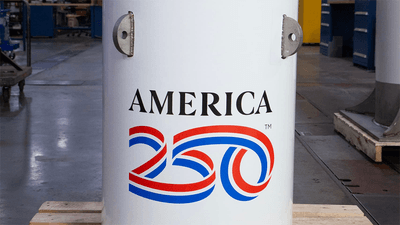


The USA is about to seal a time capsule, burying it 3 meters (10 feet) underground, with the instructions not to open it again until July 4, 2276 CE.
Those of you who are good at math or US history will instantly recognize that 2276 will mark exactly 500 years since the USA declared independence from Great Britain. Those of you who are even better at math will have noticed that 2026 is 250 years since the Declaration of Independence was signed.
It is this celebration prompting the burial of the time capsule in Philadelphia on July 4 this year.
At around 400 kilograms (900 pounds) the capsule is pretty hefty, and is designed to stay at 35 percent humidity as it waits out the next 250 years. It is hoped that the conditions will be not so moist that the contents are water damaged, and not so dry that they disintegrate.
As well as sealed water-tight, the capsule will be kept at a stable temperature by the surrounding dirt. Though 250 years is a long time to preserve artifacts pristinely, the team has high hopes for the capsule and that its contents will survive.
"Philadelphia would have to be six feet underwater in order for this time capsule to even possibly take on water," Michael Berilla, who led the team that created the capsule, told AP. "And if Philly is six feet underwater, you’ve got way bigger problems in the world."
So what exactly is America throwing into this capsule to represent the nation to the citizens of these lands, two and a half centuries in the future? The commission that organized the capsule asked each state to send objects in, leading to a collection of all kinds of interesting stuff, and a little nonsense, too.
For a start, let's hope that people in the future are huge fans of letters from governors, as these were sent by nearly 30 states.
But there are far more interesting items in there, too. California sent a fusion superconductor, a NASA topological image of the state, and a prediction from chatbot Claude on what California would be like in 250 years. The large language model suggested that bears will have returned to the Golden State, which by then will have seceded to Oregon, Washington, and British Columbia per AP.
Michigan played it sensibly, storing Petoskey stones – fossilized coral – within the capsule. Having formed 350 million years ago, the state's official stone will surely last another piddly 250 years. As well as this, they also sent a big chunk of copper ore, whilst highlighting that indigenous people began mining it in the area over 8,000 years ago.
Staying true to form, Nevada sent in a set of gambling chips and tokens, along with a commemorative coin.
As well as contributions from every state, the project sought objects from various companies and institutions. Some of these are genuinely cool.
"Among the most innovative contributions is the Library of Congress’s molecular data storage device, a tiny metal vial about the length of a pencil eraser, containing synthetic DNA encoded with digital copies of selected Library collection items," the America250 website explains.
"This cutting-edge device includes digitized historic collection items, such as Thomas Jefferson’s rough draft of the Declaration of Independence; Francis Scott Key’s handwritten lyrics for 'The Star-Spangled Banner;' an 1898 audio recording of 'The Star-Spangled Banner' by John Philip Sousa’s band; a 3D rendering of President Abraham Lincoln’s hand; the 1791 L’Enfant Plan for Washington, D.C.; the Codex Quetzalecatzin, and other rare digitized materials from the Library’s collections."
“The Library of Congress is responsible for preserving the nation’s memory, and this contribution brings that mission into the future,” Robert R. Newlen, the acting librarian of Congress, added in a statement.
“By placing some of our most treasured digitized collections into synthetic DNA, we are helping ensure that future generations can encounter foundational pieces of American history in a form designed to endure for centuries.”
Others may be of less cultural importance 250 years hence. For example, Coca-Cola donated an empty bottle of coke, with the lyrics to "I’d Like to Buy the World a Coke" from their popular 1971 advert. The Professional Golfers' Association (PGA) of America sent a divot tool, used to repair damage to a golf green during play, and a photograph of the 2026 PGA champion and his caddie.
The time capsule, containing an awful lot of poetry from various states, is set to be buried this Independence Day. By the time it is opened, its burial will be as far away from today as the burial is from the signing of the Declaration of Independence.
Who knows what future humans will make of this odd mix of rocks, letters, and photographs of golf caddies in that terrible, apparently bear-riddled future?