Technology
 PUBLISHED
 4
4


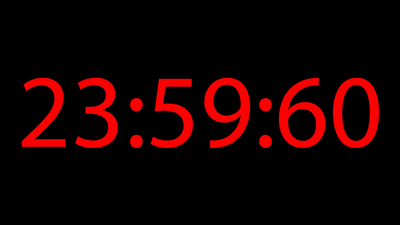


The last time that digital clocks read 23:59:60 occurred on December 31, 2016. In an update from the International Earth Rotation and Reference Systems Service (IERS), it has been confirmed that the unusual time will not occur this June, with the next available opportunity coming at the end of 2026.
So, why do the Earth's digital clocks occasionally squeeze an extra "leap second" into the year, roughly every 1.5 years? And why hasn't this happened in almost 10 years now?
First, a question for you: how long does it take for the Earth to rotate once on its own axis? If you said exactly 24 hours, you're both roughly correct, and so far from accurate that if we left you in charge of the world's satellites the transport systems below would quickly plunge into chaos.
Whilst we have functioned for around 300,000 years without the very precise co-ordination of time provided by atomic clocks, in this new age of global communication, satellite networks, and space exploration, that is no longer the case.
"Without the precise timing provided by atomic clocks, GPS wouldn’t function – and the blue dot on your phone would no longer tell you where you are," the National Institute of Standards and Technology (NIST) explains.
"Navigation is just one area where atomic clocks have had a profound impact on our lives. When you fly, GPS helps your pilots land the plane safely. If you buy or sell a stock, your transaction is stamped using atomic time. When you send an email, the time stamp ultimately traces back to atomic clocks as well. The power grid we rely on is regulated and synchronized using atomic time."
From 2007 onwards, the official US time (known as NIST UTC) has been set by NIST. It does so by using the average of 16 atomic clocks, measured using "the duration of 9,192,631,770 periods of the radiation corresponding to the transition between two hyperfine levels of the ground state of the cesium-133 atom".
It's an effective system, but there is the slight problem that the Earth's rotation does not keep such an accurate schedule. Generally, and largely due to the influence of the Moon moving away from the Earth, our planet's rotation is slowing down. In order to keep the time synced up with the rotation of the Earth, a leap second needs to be added around once every 1.5 years.
That is the general rule, but the Earth's rotation is not just affected by the Moon. For example, in 2011 a magnitude 9.0 earthquake off the coast of Japan caused the Earth's rotation to speed up by about 1.8 microseconds.
"The Japanese landmass was moved around by as much as 4 [meters; 13 feet]," explained meteorologist Bethan Harris to the BBC at the time. "This redistribution of mass on the surface changes our moment of inertia. In order to conserve angular momentum, the changes in inertia are compensated by changes in the rate of rotation of the Earth about the axis."
In essence, any event or project that involves shifting mass around can affect the planet's rotation, with China's Three Gorges Dam being the classic example. That structure is so large, and is capable of holding so much water, it could increase Earth's day length by around 0.06 microseconds.
In nearly 10 years, humanity has not needed to add a leap second, and the explanation is quite simple; the Earth's rotation has been speeding up again. Since records began in the 1960s with the advent of atomic clocks, the Earth's rotation has been slowing down on average, but that trend reversed in 2020, when the record for the shortest day was broken 28 times over.
There has even been talk of adding a negative leap second to keep in line with the Earth's rotation, though this has not been deemed necessary as yet.
The cause is not entirely clear, though it is likely due to shifts in the Earth's mass, with melting glaciers and water storage in northern hemisphere reservoirs being suggested as key suspects. Nevertheless, it appears that in June it will not be necessary to add a leap second.
If it is not deemed necessary to add a leap second, that will mark 10 years since the clock last read the unusual time of 23:59:60, as they do on these leap second days.