


 Nature
 PUBLISHED


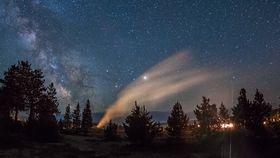


The beauty of Yellowstone is world-renowned. But when the Sun goes down, it’s a different beast altogether.
Gracing crossroads between Idaho, Montana, and Wyoming, Yellowstone National Park is the United State’s oldest national park. It’s home to wolves, bison, elk, bears, geothermic vents, waterfalls, a supervolcano, and some rather divine skies.
This supervolcano, the Yellowstone Caldera, is the largest volcano in the United States and towers at 2,805 meters (9,203 feet) tall and stretches over a space of 55 by 72 kilometers (34 by 45 miles ). It has not erupted for around 70,000 years, but its pulsing geothermal vents serve as a constant reminder of its presence – and its dangers.

Yellowstone's hot springs give out a sigh. Harun Mehmedinovi?/SKYGLOW
This time-lapse video, titled Hades Exhales, is dedicated to Colin Nathaniel Scott, who died after falling into a hot spring at Yellowstone just a few days after this video was filmed.
It was created as part of SKYGLOW, a crowdfunded project that documents and explores the beauty of the night sky, in the hopes of raising awareness about urban light pollution. After all, it’s estimated one-third of humanity can’t see the Milky Way at night because of excess light pollution.
"As always, weather is a challenge for astrophotography and my first night at Yellowstone turned out to be quite overcast, despite the weather reports, so I came back and had more luck next time," director Harun Mehmedinovi? told IFLScience. "I used three Canon 5DSR / 5DIII cameras to capture as many shots as possible in the 7 to 8 hours of night that I had. With night timelapse like these, you need to film around 2 hours to get about 10-seconds of footage, shot with 25-second exposures, at 30-second intervals."
While a video can never truly capture nature’s beauty, this video is the next best thing to camping under the stars.
Head over to the SKYGLOW wesbite to help support the project.



 1
1