Space and Physics
 PUBLISHED


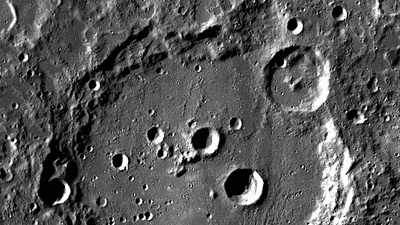


This week, if you looked up at the right time and with the right equipment, you may have witnessed a "V" and an "X" shape on the surface of the Moon. While your chance to see that event has passed (for now), it is possible to witness another lunar event on Friday, July 4, as the "Eyes of Clavius" appear on the lunar surface. Like the lunar "V" and "X", this is a Clair-Obscur effect, which is only visible at certain times in the lunar cycle.
Every celestial body orbiting the Sun has a terminator. That's the line that divides the day side and the night side of the body in question, rather than a killer robot from the future played by the guy from Kindergarten Cop. The Moon is no exception, and the line gives us an opportunity to figure out its three-dimensional shape.
"The lunar surface appears different nearer the terminator because there the Sun is nearer the horizon and therefore causes shadows to become increasingly long. These shadows make it easier for us to discern structure, giving us depth cues so that the two-dimensional image, when dominated by shadows, appears almost three-dimensional," NASA's Astronomy Picture of the Day website explains.
"Therefore, as the Moon fades from light to dark, shadows not only tell us the high from the low, but become noticeable for increasingly shorter structures. For example, many craters appear near the terminator because their height makes them easier to discern there."
When the Sun hits the rims of the Blanchinus, La Caille, and Purbach craters at just the right angles during the Moon's cycle, it produces the lunar X and V. When it hits the Clavius crater, one of the Moon's largest and oldest, just right you can see the "Eyes of Clavius".
"Clavius has several satellite craters along its floor. Clavius C and D, with diameters 21km and 28km respectively, have walls that are higher than the crater floor," amateur astronomer and science communicator Mary McIntyre explains. "As the Sun rises over Clavius, the tops of these crater walls catch the sunlight before the rest of the crater floor and this creates two white rings that resemble a pair of eyes looking out from the shadowy crater floor."
When to see the Eyes of Clavius on the Moon
There are a couple of options this month as there are two schools of thought that say the "Eyes" are better to observe during the waning or waxing Moon in the first or third quarter phase.
The first opportunity is Friday, July 4, two days after the first quarter. It's a daytime Moon viewing, so it may be difficult, but have a look from around 11am EDT (3pm UTC). You will need a small telescope to see it, though you can observe the Clavius crater itself with a good set of binoculars.
You may also be able to see it on Wednesday, July 16, two days before the start of the third quarter phase.