Technology
 PUBLISHED
 1
1


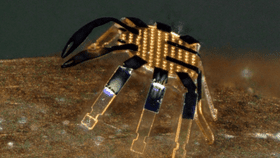


This remote-controlled walking robot is the smallest ever created, and it could one day be scuttling around inside you.
Say hello to the peekytoe crab robot which is able to move without complex hardware, hydraulics, or electricity. Instead, the locomotion is created by the robot’s shape-memory alloy, which deforms into its remembered shape when heated.
A laser is used to rapidly heat the robot at different targeted locations, and a thin coating of glass elastically returns that part of the robot to its deformed shape when cooling. As the robot changes shape from deformed to remembered and back, this action creates the locomotion. The laser can control the direction of travel, and the robot can crawl, twist, walk, turn, and even jump. The research is published in the journal Science Robotics.
Researchers at Northwestern University were inspired by the mechanism used in children’s “pop-up” books to create the tiny robot crab. The weeny bot is 0.5 millimeters (0.02 inches) wide, making it even smaller than a flea, and it is hoped that similar robots could one day be used to perform tasks in tight spaces, including within the human body.
Video credit: Northwestern University