Technology
 PUBLISHED


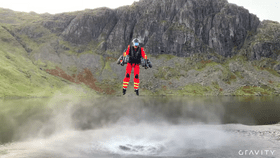


Is it a bird? Is it a plane? No, but it might be your local emergency service.
A recent demonstration involving the Great North Air Ambulance Service (GNAAS), UK, showed a radical new Avengers-style approach to difficult mountain rescues – a first responder rocketing up to the patient using a jetpack.
GNAAS tested the jetpack produced by Gravity Industries in the Lake District with founder Richard Browning giving a full demonstration. Strapped with dual jets on both sides, he flew from valley floor to a simulated casualty site on the side of Bowfell mountain in just 90 seconds, a marked improvement on the roughly 25 minutes it would usually take on foot, says GNAAS director of operations Andy Mawson.
Browning demonstrates the jet suit. Credit: Gravity Industries
Of course, these are just trials for now. GNAAS hopes that one day jet suit paramedics will be able to access injured travelers quickly, armed with defibrillators, medical kits, and pain relief medication.
“We think this technology could enable our team to reach some patients much quicker than ever before. In many cases, this would ease the patient’s suffering. In some cases, it would save their lives," Mawson said in a statement.
The jetpacks utilize two jets on each arm and one on the back, allowing for enough thrust to power the wearer while the arms provide the control. By pointing the jets down, the wearer is propelled upwards, whilst a wider angle lowers the wearer to the ground.
The jet suit is not for the faint of heart. Propping yourself up on arm jets requires an immense amount of endurance from the wearer, so training is needed. Couple that with a top speed of 136 kilometers per hour (85 miles per hour), which beat out the previous jet suit record of just 51.5 kilometers per hour (32 miles per hour), and you quickly realize why the suit may be a niche piece of equipment.
However, there are options available to purchase a jet suit yourself – if you’re willing to part ways with $440,000 (£342,000), that is. Keep in mind, the video may have made using the equipment look easier than it actually is, as CNBC reported.
[H/T: BBC, Gravity Industries]