Technology
 PUBLISHED
 33
33


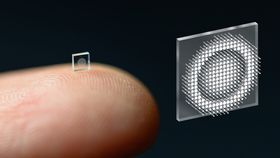


A camera just half a millimeter wide that can produce photos like a camera with a lens 500,000 times bigger in volume has been developed by researchers at the University of Princeton and the University of Washington. The technological breakthrough could be used to find medical issues or as a sensing apparatus for extremely small robots.
The camera, described in a paper published in Nature Communications, works thanks to something called a metasurface. This material is coated with 1.6 million cylindrical posts, each the size of a human immunodeficiency virus (HIV) particle. Each post works as an optical antenna and has a precise design. Without this, the camera would not be able to correctly take in all the light reflected off an object.
Once the light is in the metasurface, it reaches an integrated optical surface and is then processed by a signal process algorithm. The whole setup is known as Neural Nano-Optics, and is a significant step forward from the previous state-of-the-art micro-sized cameras.

“It’s been a challenge to design and configure these little microstructures to do what you want,” co-lead author Ethan Tseng, a graduate researcher at Princeton, said in a statement. “For this specific task of capturing large field of view RGB images, it was previously unclear how to co-design the millions of nano-structures together with post-processing algorithms.”
The team is now looking into expanding the computational abilities of the camera. They not only want to continue making the image better, but they are also investigating how to add capabilities for object detection and other features that might make this a revolutionary instrument for medicine and robotics.