Health and Medicine
 PUBLISHED


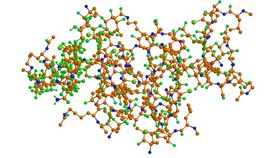


One of the most-used antibiotics in the world has been given an addition, making it far more lethal to antibiotic-resistant bacteria. In a world desperately running out of defenses against bacterial diseases, the modification may have come just in time.
For 60 years, vancomycin has been saving lives, widely prescribed for staph infections and diarrhea, among other potential killers. The first case of resistance was reported in 1987. Today, bacteria resistant to it are appearing widely, but Professor Dale Boger of The Scripps Research Institute described it as “magical” for the time it has lasted, indicating that its disruption of bacterial cell wall maturation is particularly hard to overcome.
While other researchers have been chasing new antibiotics that don't resemble anything we have today, Boger sought to breathe new life into vancomycin. He has previously published work on two changes to the drug that add a different method for interfering with cell wall formation. "With these modifications, you need less of the drug to have the same effect," Boger said in a statement.
Now, Boger has published a third modification in the Proceedings of the National Academy of Sciences. Putting the three modifications together produced a drug that is 6,000 times as potent against vancomycin-resistant enterococci (VRE) as the original. The World Health Organization rates VRE as among the most dangerous drug-resistant bacterias.
In addition to his previous changes, Boger added an extra ammonium salt, making the cell walls that do form too permeable to do their job. He expects this to increase its staying power further. "Organisms just can't simultaneously work to find a way around three independent mechanisms of action," he said. "Even if they found a solution to one of those, the organisms would still be killed by the other two."
Tiny doses of the new drug were shown to kill non-resistant enterococci bacteria, along with VRE.
Currently, it takes 30 steps to synthesize Boger's product with all three tweaks included, making it prohibitively expensive for widespread use. Boger believes it will be easy to cut this process down, but has yet to demonstrate how.
Even if this cannot be done however, super-vancomycin could prove useful as a drug of last resort, to be rolled out only in cases where cheaper drugs have failed. Indeed, public health workers argue this is what we should be doing with new antibiotics, using them as sparingly as possible to slow the development of resistance. Unfortunately, this idea has been met with rather less support from the companies that sell the new products, who are understandably keen to see their drugs used as widely as possible to maximize profits, and Boger argues a drug with three mechanisms of action could avoid this dilemma.