Space and Physics
 PUBLISHED





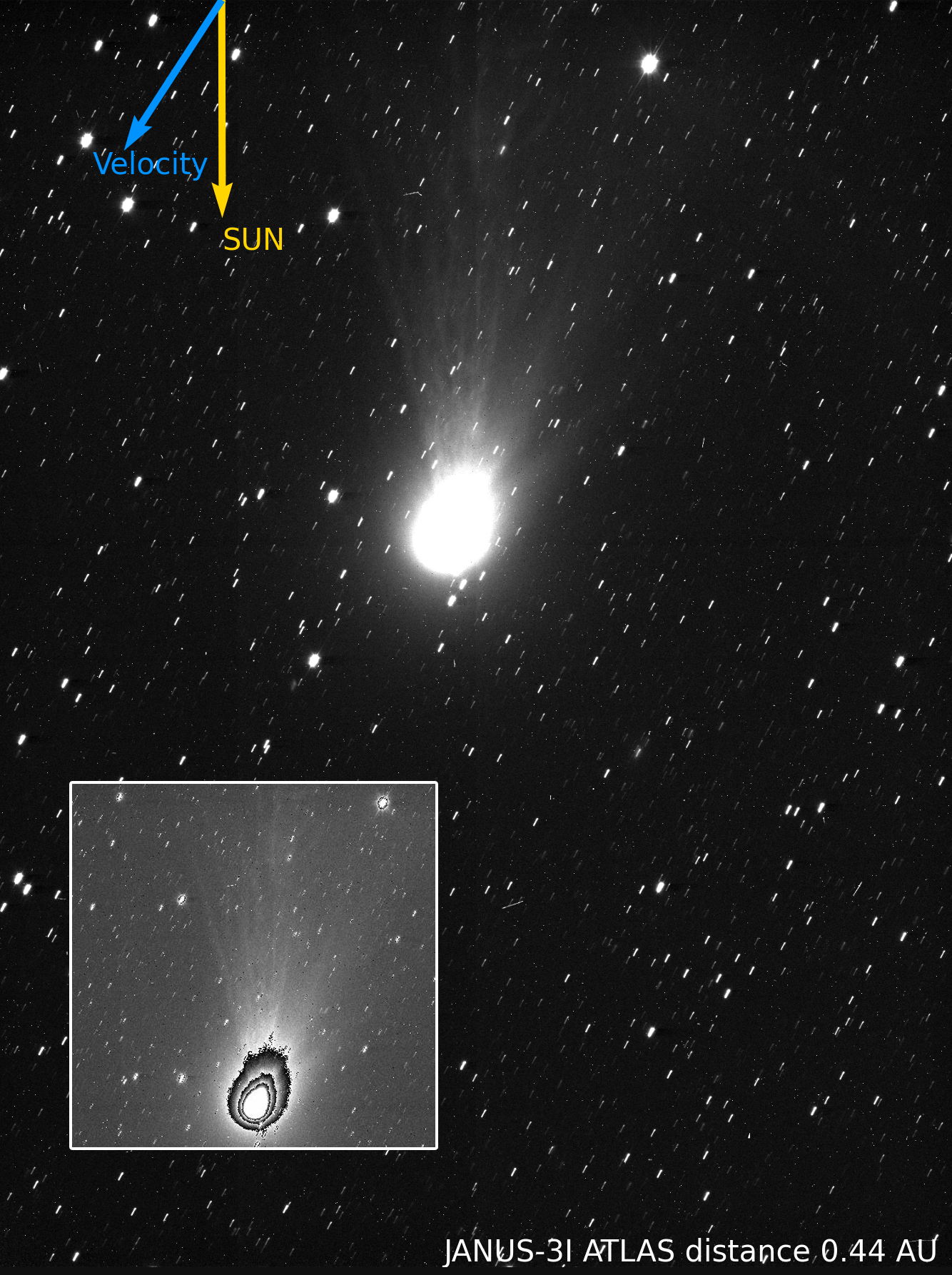
A European mission intended to study Jupiter's moons has just released one of the best pictures yet of comet 3I/ATLAS, as the mysterious interstellar object begins its journey back into deep space.
When the Jupiter Icy Moons Explorer (JUICE) mission announced it was going to observe interstellar comet 3I/ATLAS in October 2025, we were told we would only get detailed images and insights in 2026. Looking at the newly released image, we agree with the European Space Agency (ESA): good things come to those who wait.
The snap, taken by the JANUS camera, is one of the best yet taken of the comet, and it will likely remain the best taken from beyond Earth. It is particularly important because it was captured on November 6, 2025, just one week after 3I/ATLAS's perihelion, its closest point to the Sun, when the comet was just 210 million kilometers (130 million miles) from our star. JUICE itself had a vantage point 66 million kilometers (41 million miles) from the comet.
ESA had previously released a navigational camera photo, showing the basic features of 3I/ATLAS. And there are still treasures to be unearthed. This is just one of 120 images taken by JUICE's JANUS camera, plus there is all the data from the spacecraft's near-infrared imaging instrument, its UV spectrometer, the submillimeter instrument, and a sensor to image neutral atoms. In short, there is a lot more to learn about this peculiar interstellar interloper.
JUICE is making its way to the Jovian system, where it will study the gas giant's icy moons: Ganymede, Callisto, and Europa. Its goal is to characterize the interior of these worlds, as we suspect all three may be hiding liquid oceans. It will also become the first spacecraft to enter orbit around Ganymede, the largest moon in the Solar System and the only one with a magnetic field. That work isn't due to start until the 2030s, and the craft was supposed to be mostly idle until then, but serendipity put it close to 3I/ATLAS last year.
“This campaign was unexpected for everybody! For JUICE, indeed, we are in a cruise phase during which there are thermal constraints, being relatively close to the Sun (with respect to the science phase around Jupiter)," Olivier Witasse, ESA Project Scientist, told IFLScience back in October when the campaign was announced. "Therefore, no payload activities were expected to take place at this moment. However, given the uniqueness of these observations, it was decided to prepare this extra observation planning.”
“Stay tuned for an update from us,” ESA has announced, and we can’t wait to see what else will come from JUICE. This might be one of the closest observations of an object from deep space, unless a very bold and daring mission to catch up with the comet in three decades finds some support.


 1
1