Humans
 PUBLISHED
 1
1


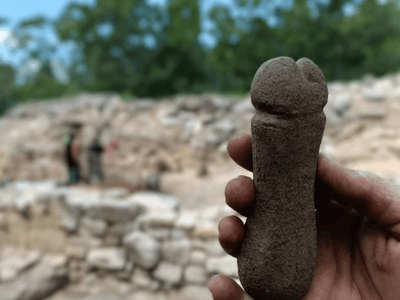


A 15-centimeter (6-inch) stone penis has recently been unearthed during excavations at a medieval fortress in southwest Spain. While phallic objects were not uncommon in the ancient world, most notably in the lands of the Roman Empire, it’s pretty strange to find one dating from the European Middle Ages.
However, unlike similar artifacts from the age of the Romans, this recently discovered object has a unique function. Instead of serving as a good luck charm or decoration, the archaeologists who made the discovery believe it was a tool used to sharpen weapons like a whetstone.
The stone penis was found at Torre de Meira, the site of a medieval fortress in the municipality of Moaña that sits on top of a hill overlooking the Ría de Vigo. The castle was destroyed in 1476 CE during the Irmandiño Wars, a popular revolt in which peasants rose up against the Spanish nobility.

This kind of chaos was rife across much of Europe in the 14th and 15th centuries in the wake of the Crisis of the Late Middle Ages. Against the backdrop of religious conflict and political instability, the Black Death ravaged much of Europe and left the disgruntled masses hungry for revolution.
After laying in ruins for hundreds of years, Torre de Meira was eventually excavated in 1976, revealing a complex of walls, an armory, a moat, and a large watchtower.
Over the past three years, Árbore Arqueoloxía has been working at the site, using their archaeological expertise to reveal a whole host of fascinating finds. They discovered the stone penis on May 19 around the ruins of the main building.
Based on distinct scratches found along the object, they believe it was used as an ornate whetstone that allowed soldiers to sharpen their swords in a boisterous display of hyper-masculinity.
“It materializes the symbolic association between violence, weapons, and masculinity. An association that we know existed in the Middle Ages and that is present in our culture today,” said Darío Peña, an archaeologist at Árbore Arqueoloxía who works on the project, according to Hyperallergic.