Space and Physics
 PUBLISHED
 1
1




Astronomers who study the evolution of stars are used to events taking place on timespans far beyond a human lifespan. Yet a century of observations of the variable star T Ursae Minoris (T UMi) indicates it is nearing its death and may experience an important shift within decades. Moreover, while larger than the Sun, T UMi is close enough that they are categorized together.
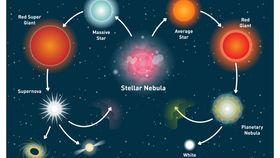
Stars with masses more than eight times that of the Sun go out in a blaze of supernova glory, something we can watch occur over a matter of weeks. Smaller stars, however, move at a slower pace and end in a far less spectacular manner.
All those with masses 0.5-8 times that of the Sun eventually throw off their outer layers, leaving their cores to become white dwarfs. We believe this based on a combination of modeling and observations of stars at different points on the journey. However, the process is so slow we've never seen it happen, or even witnessed the transition between stages on the journey.
Now, however, Dr Meridith Joyce of the Australian National University and colleagues have analyzed T UMi's behavior in The Astrophysical Journal. Since 1905 amateur astronomers have recorded its brightness varying by a factor of more than 100, which for most of that time took place on a 310 to 315-day cycle. Since 1979 the variations have become faster, falling to 114 days, and the variability much less.
Joyce concludes T UMi is throwing off its outer layers in a series of pulses, each lasting a few centuries. “Energy production in T UMi has become unstable. During this phase, nuclear fusion flares up deep inside, causing 'hiccups’ that we call thermal pulses,” Joyce said in a statement.
Joyce predicts the current shrinkage will end in 30-50 years, at which point T UMi will start to grow and cool down again. She hopes to still be working in astronomy when her prediction is vindicated.
Based on its mass and size in Joyce’s modeling, it should take T UMi around 25 pulses to throw off all its outer layers, 5-10 of which are still to come.
The Sun has around half of T UMi’s initial mass (although a sixth of T UMI's has gone), which, Joyce told IFLScience, means its pulses will be shorter and there will be many fewer of them if it experiences any at all. It won't happen soon, however. Joyce said: “The Sun has at least 5 billion more years to go before entering the red giant phase.” At that point it will expand to swallow Mercury, Venus, and possibly the Earth before it too declines, pulses or not, to end as a white dwarf.
The material T UMi is dispensing with includes plenty of carbon and nitrogen, as well as lesser amounts of metals like tin that will be absorbed into a following generation of star systems and help build new planets.