Space and Physics
 PUBLISHED
 3
3


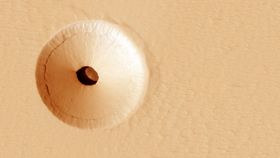


Every day we seem to learn something new about Mars' surface thanks to the multiple missions either on or circling the Red Planet, snapping away. Like the fact that it looks delicious or has huge holes, which would make it a golf course fit for a giant.
We’re pretty sure that’s not what this hole is. According to NASA, who shared the image as part of its Astronomy Image of the Day series, the hole is likely an opening to an underground cavern. Still, excitingly mysterious.
The image of the hole, approximately 35 meters (115 feet) across, was discovered by accident in 2011. At the time, the HiRISE instrument aboard NASA’s Mars Reconnaissance Orbiter, which is currently orbiting Mars, was snapping photos of the dusty slopes of Pavonis Mons volcano.
Analysis of the image, and follow up photos, revealed that it appears to be an opening to an underlying cavern. The shadow of the hole’s entrance reveals its depth, thought to extend around 20 meters (65 feet) deep, though it could be much larger.
The most likely scenario is that it’s the opening to a lava tube. The hole is on the western slopes of Pavonis Mons, which has many well-documented lava tubes. As the lava rolls down the slopes, it can solidify on the surface while still moving underneath. When the lava drains away, it can leave hollow tubes, and if a section of the roof collapses, it creates a skylight, or hole, much like those that occur on Earth. Why there is a circular raised crater around the hole, however, is still a matter for debate.
What isn’t up for debate is how important these holes are for researchers to explore. Because their interior caves are relatively protected from Mars’ harsh surface – with a thin atmosphere, the planet is more subject to the Sun’s heat and radiation – such holes are considered good candidates for supporting or containing evidence of life on Mars. Probably not the alien cowering in a hole kind, though.
The deeper you go on Mars, the warmer it gets, which means at some point conditions may have been right for liquid water to be stable. Subterranean structures may have trapped water vapor at one point, protecting it from the surface onslaught. This makes them important targets for future missions looking for life. Plus it's a lot easier to drill down to look for minerals or gases when you're already 20 meters (65 feet) below the surface. As NASA's InSight mission is demonstrating, this is not as easy as hoped.
They could also make convenient potential habitats for future astronauts. It looks like the kind of place Mark Watney might have holed up in during The Martian's epic dust storm if he'd known about it (and, those kinds of dust storms could actually exist on Mars).