Space and Physics
 PUBLISHED
 8
8


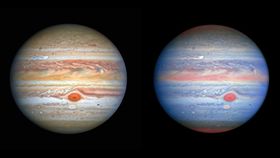


Last Month, Hubble took a beautiful new photo of Jupiter and its icy moon Europa. The swirling clouds and giant storms that move across its atmosphere are caught in incredible detail in this image. And if beauty is not enough in itself, it also captured some exciting science.
The image was taken when the largest planet in our Solar System was 653 million kilometers (406 million miles) from Earth, over four times the distance between our planet and the Sun. The image shows two crucial changes to the Jovian atmosphere, one in each hemisphere. The observations were conducted on August 25.
In the Northern Hemisphere, at about mid-latitudes (just above Europa in the image below), there is a bright white stretched storm with winds moving at a whopping 560 kilometers (350 miles) per hour. This dramatic plume was first spotted on August 18 and since then a second one has formed.
These kinds of storms are not unusual on Jupiter, but astronomers are perplexed by some darker splotches that trail behind the plume. These have been observed before, leading researchers to wonder if we are witnessing the formation of a major storm in the Northern Hemisphere.

The Southern hemisphere of Jupiter already has major storms raging. The Great Red Spot has precedence in both age (several centuries) and size, 15,770 kilometers (9,800 miles), much larger than Earth. But it is not alone. Oval BA (just below the Great Red Spot in this image) formed in 2000 after the collision of three white storms. By 2006, the storm had changed color, turning crimson and gaining the name of Red Spot Jr.
Since then, the storm has been fading back to its original white but it appears this is not happening anymore. The center of the storm may be changing back to red. It is still many shades away from the Great Red Spot, but it is clearly not white anymore.
The team also collected a beautiful image of what the planet looks beyond the visible spectrum of light. The combination of observations from ultraviolet to the near infrared, represented in a blue, white, and pink combo, highlights the haze particles that are present in the atmosphere of Jupiter. The observations help astronomers to work out how deep in the atmosphere the haze is located.