Space and Physics
 PUBLISHED
 13
13






A galaxy 236 million light-years away has experienced a very peculiar outburst in its central region. Analysis of the observations suggests that the likely culprit is a magnetic field reversal — something that has not been seen before.
Reporting in a paper accepted for publication in The Astrophysical Journal, the All-Sky Automated Survey for Supernovae was the first to notice galaxy 1ES 1927+654 brightening in visible light by nearly 100 times. This was back in March 2018, but a search for previous changes led the team to discover that the object had been brightening for a few months at that point.
NASA’s Swift observed the galaxy in May 2018, seeing elevated ultraviolet emissions roughly 12 times brighter than expected. But it was decreasing, which suggested that the peak had been missed. At that point, the galaxy was one among a small number of objects that has been seen acting in this way. In June 2018, however, it became unique. Its X-ray emission disappeared completely.
“Rapid changes in visible and ultraviolet light have been seen in a few dozen galaxies similar to this one,” Dr Sibasish Laha, a research scientist at NASA’s Goddard Space Flight Center, said in a statement. “But this event marks the first time we’ve seen X-rays dropping out completely while the other wavelengths brighten.”
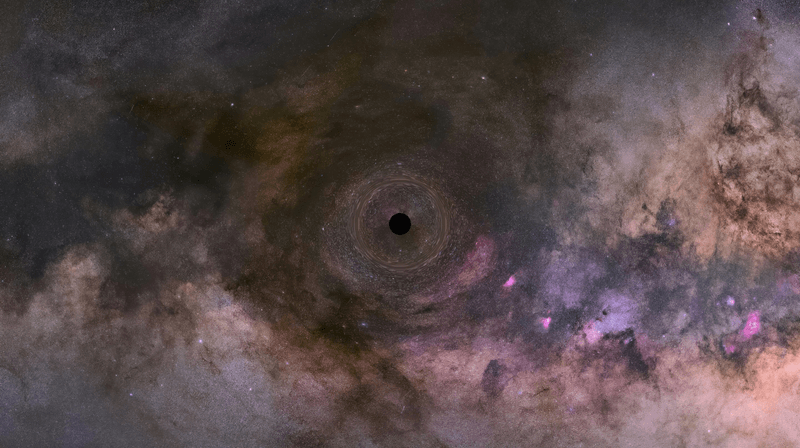
At the center of almost every galaxy – and maybe all of them – lies a supermassive black hole. The enormous and extremely dense objects feed on material that eventually forms an accretion disk around them. The black hole itself is then shrouded by a cloud of extremely hot particles, the corona, that emit very high-energy X-rays.
Magnetic fields from black holes are thought to be key in maintaining the corona. But the first explanation of what had happened here was that the system was disrupted by a star that got too close and was ripped apart and turned into plasma. Now astronomers favor the idea that the magnetic field of the supermassive black hole just flipped.
“A magnetic reversal, where the north pole becomes south and vice versa, seems to best fit the observations,” said co-author Mitchell Begelman, a professor in the department of astrophysical and planetary sciences at the University of Colorado Boulder. “The field initially weakens at the outskirts of the accretion disk, leading to greater heating and brightening in visible and UV light."
Magnetic field reversal has happened to Earth often in geological times, and now this finding suggests that many other objects experience it in the universe,too.