Space and Physics
 PUBLISHED


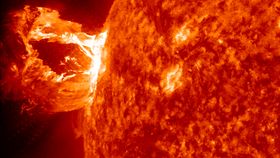


NASA’s Fermi Telescope looks at the high-energy universe, and once in a while catches the Sun flare up during solar storms. Some of the recent emissions from the Sun surprised scientists. Fermi shouldn’t have been able to see them as the solar storms were happening on the far side of the Sun.
In a paper, published in the Astrophysical Journal, the team discuss the cause of these curious events, known as behind-the-limb flares. A solar storm is associated with the sudden emission of huge clouds of charged particles, accelerated to almost the speed of light by powerful magnetic fields.
Some of these particles escape into space, but others follow the magnetic field of the Sun, and the latter eventually slam back into the Sun's surface. In doing so, they release a lot of gamma-rays.
 The three solar flares behind the gamma-ray emission detected by Fermi. NASA/STEREO
"Fermi is seeing gamma rays from the side of the Sun we're facing, but the emission is produced by streams of particles blasted out of solar flares on the far side of the Sun," said author Nicola Omodei, a researcher at Stanford University, in a statement. "These particles must travel some 300,000 miles within about five minutes of the eruption to produce this light."
The link between the gamma-ray emission and the solar flares was possible thanks to NASA’s Solar Terrestrial Relations Observatory (STEREO) spacecraft, which was observing the far side of the Sun during the three observed events that occurred in 2013 and 2014.
"Observations by Fermi's LAT continue to have a significant impact on the solar physics community in their own right, but the addition of STEREO observations provides extremely valuable information of how they mesh with the big picture of solar activity," added co-author Melissa Pesce-Rollins, a researcher at the National Institute of Nuclear Physics in Pisa.
The Sun is quite dim in gamma-rays, but being so close, its emission can become quite powerful when it becomes more active. The most powerful emission Fermi ever detected from our star happened in 2012, when the Sun emitted gamma-rays for the record-breaking time of 20 hours.