Technology
 PUBLISHED


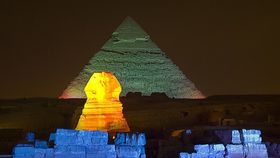


The pyramids of Giza have left us gazing in astonishment and curiosity for four thousand years. Even after hundreds of years of archeological and scientific exploration, they’re continuing to surprise us. A recent project has found striking “thermal anomalies” in the eastern side of the Great Pyramid of Giza.
The discovery was part of the Operation Scan Pyramid, a recent project that has already used “cosmic rays” and drones to analyze the pyramids by a group of scientists from Egypt, France, Canada and Japan, under authority from the Egyptian Antiquities Ministry.
With the ongoing plan to discover new tombs and hidden burial chambers, the project used thermal imaging technology on the pyramid, which found mysterious heat spots on the monuments. At the lower level of the Cheops, or Great Pyramid, they found an area of neighboring blocks that had a temperature gap far greater than would normally be expected for adjacent stones made with different qualities of limestone.
Since air gaps don’t hold heat as well as rock or sand, a difference in temperature could reveal information about the pyramid’s structure hidden beneath the surface. However, the team still aren’t certain what exactly it is. It could be a tomb, a cavity, a passage or even just a crack in the rock.
In a statement, the Egyptian antiquities ministry said the scientists had “concluded the existence of several thermal anomalies that were observed on all monuments during the heating-up or the cooling-down phases,” referring to surveys taken during sunrise, when the structures warm up from the Sun, and sunset, when they lose heat.
“To explain such anomalies, a lot of hypotheses and possibilities could be drawn up; presence of voids behind the surface, internal air currents,” it added.
These three pyramids of Giza were built around 2613 and 2494 B.C.E. Cheops pyramid – where the greatest thermal anomaly was found – is the largest and oldest of the monuments, which was built for Pharaoh Khufu (whose name in Greek translates of Cheops).
“Khufu will offer us today one of its secrets,” Mamduh al-Damati, the Egyptian antiquities minister, told reporters at the pyramid.
Operation Scan Pyramids began on October 25 and is expected to go on until the end of 2016. The next step is a long-term infrared survey of all the pyramids.
Main image credit: Ernie R/Flickr. (CC BY-NC-ND 2.0)



 2
2