Space and Physics
 PUBLISHED
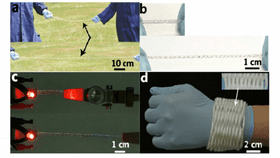


A team of researchers based at Fudan University, China, has developed a super-stretchy lithium-ion battery that can be stretched by 600% whilst still maintaining impressive electrochemical properties. The study has been published in the Journal of Materials Chemistry.
Stretchy electronic devices are becoming surprisingly useful in today’s technology and they have many promising applications. For example, they could be used in the development of electronic skins to monitor various health conditions or smart gloves for surgery. However, batteries have generally limited the applications of stretchy electronics because conventional batteries are usually rigid. There has therefore been a need to develop stretchable batteries to meet the needs of these electronic devices.
To create their super-stretchy battery, scientists wound two carbon nanotube composite fibers with a silicon-based elastomer substrate. The fibers were incorporated with either lithium manganate or lithium titanate; these served as the positive and the negative electrodes. They then coated this electrode assembly with a layer of gel electrolyte to seal the battery. This combination of twisted electrodes, elastic substrate and gel electrolyte allowed the battery to be super-stretchy.
When the scientists stretched this battery, the spring-like structure of the electrodes was maintained. They were able to stretch it by 600% whilst retaining a specific capacity of 91.3 mAh/g.
These batteries could be particularly useful in the development of wearable or portable electronic devices. “Our fiber-shaped batteries can easily be scaled-up to an appropriate length and woven into clothing that can adapt to the body’s movement,” lead researcher Huisheng Peng told Chemistry World.
If you’d like to see a demonstration of the battery, check out this YouTube video released by Fudan University: