Health and Medicine
 PUBLISHED




Anxiety can act as a great motivator to avoid potentially uncomfortable interactions, and it seems that even rats may fall victim to it. A new study involving rats being let loose in a maze populated by food-guarding robots has revealed how their brains behaved when anticipating future threats, changing their behavior so that they could avoid bumping into them. The findings underpin the role of the hippocampus in anxiety-like behaviors, a mechanism that could be an important target for anxiety medications.
Worrying about future events becomes particularly significant in “approach-avoidance conflict,” whereby we are put off getting something we want because we're concerned about encountering something unpleasant in the process. For humans, that might be retrieving your post from the weird neighbor it was left with – but to model the same behavior in rats, scientists turned to robots.
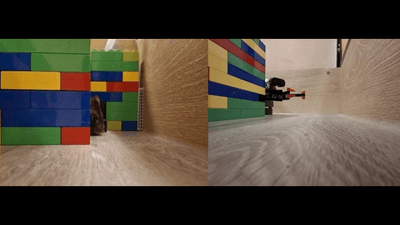
They created an L-shaped arena with the rats at one end and food at the other, but around the corner, a food-guarding robot was lurking. The "robogator," as it was nicknamed, would sometimes simulate an attack on the rats when they approached, charging forward while screeching and moving its jaws and tail – and suffice it to say, the rats were not a fan. The presence of the robogator was enough to alter their behaviors, hesitating before even beginning the assault course, hiding around the corner, and sometimes abandoning the mission altogether.
The researchers were able to get a look at what was going on in the rats’ brains while all the drama was unfolding, meaning they could map which cells were active when the rats reached the robots or the food. These cells are known as “place cells,” a type of neuron in the hippocampus that fires when an animal enters a specific location in the environment.
Their brains revealed that after the rats had been “attacked,” the place cells associated with the robot were more likely to be firing than the food ones, but both did still activate. When they gave up altogether and turned back, they only showed activity in the place cells for the robot. Could it be that this system involved in mapping plays a crucial role in what we know as worry? Does the brain create its own "worry map"?
“Theories have long hypothesized that anxiety involves imagination, and worry involves negative episodic thinking,” wrote the authors. “Extensive data has identified a role for the hippocampus in the imagination of other places and other times, and, in particular in planning, particularly about positive futures to approach. Here, we find that these same hippocampal processes also encode important information about negative events, both experienced dangers and potentially dangerous futures.”
The researchers also observed that the rats exhibited fewer worry-related behaviors when they were given the drug diazepam, aka Valium, which is sometimes given for anxiety. It also had an effect on their brain activity, reducing the neural patterns in the hippocampus associated with anxiety-like behaviors.
It’s hoped that now we better understand this relationship between place cells and negative events, we may be better placed to understand the neuroscience of anxiety.
The study is published in the journal PLOS Biology.