Nature
 PUBLISHED


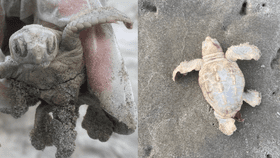


Leucism is a term used to describe a range of conditions that results in animals who are lacking in some or almost all pigment. The aesthetic result is different degrees of white, pale, or patchy coloration in the form of whatever threads the animal is sporting, be it skin, hair, feathers, scales, or cuticles. They are not always completely white and their eyes maintain their pigment, producing absolute lewks throughout the Animal Kingdom. Last weekend, one such leucistic fashionista was discovered flippering its way along the shores of South Carolina by a group of turtle conservation volunteers.
The discovery was reported on Sunday by residents of the town of Kiawah Island who shared on Facebook that the Kiawah Island Turtle Patrol (KITP) had come across a rare white hatchling. The uncharacteristically pale turtle was making its way to the shore having emerged from its nest higher up in the sand. "You can imagine the excited 'oohs' and the 'aah’s' from the guests, including some College of Charleston students, when the patroller found a lone, leucistic hatchling in the nest," Kiawah Island said in the post.
The hatchling’s unique coloration is thought to be the result of the leucistic genetic condition, giving the young turtle a brilliant white shell and body with contrasting dark eyes. While a rare find, the turtle's white coloration could make life in the open ocean difficult. Baby turtles will shelter in seaweed to keep out of sight of predators and while their traditional coloration of greyish-green makes this the ideal hiding spot, it might be less effective for a bright white turtle.
"This morning, our Kiawah Island Turtle Patrol #KITP, Zone 8, inventoried the last nest on the island. #338,” said Kiawah Island on Facebook. “The patroller found a lone, leucistic hatchling in the nest… It was a first for everyone in attendance!”

Other exceptional examples of leucism include Omo, an extremely rare white giraffe who was named after a popular detergent brand. Beach-goers in Australia were also stunned to find a shark that had washed up on the shore and really put the “white” in Great White. The enormous fish still had the characteristic black eyes of a Great White, which were all the more striking against its white flesh. That the eyes still have their pigment is what separates leucism from albinism, a condition that causes a total loss of pigment and presents with red or pink eyes. Leucistic animals may still have a small amount of coloration in their fur, feathers, or shell.