Space and Physics
 PUBLISHED




NASA’s rovers on Mars, Curiosity and Perseverance, have given us some pretty great views of clouds from the Red Planet lately. Cloud spotting is taken seriously by these robotic explorers, delivering many insights into the Martian weather patterns – and sometimes it features surprise guests, like Deimos.
In a recent series of images taken by Perseverance, we can see the diminutive moon of Mars as it becomes visible in the Martian twilight. The sequence of images was taken within two minutes around 7 pm local time of the rover's 173rd day on Mars. That’s August 15 for us.
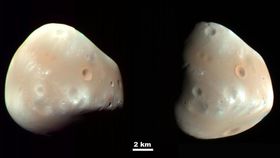
Deimos takes its name from the god of dread and terror in the Greek Pantheon. He’s the son of Ares (Mars) and brother to Phobos – the namesake of the other satellite of Mars. Deimos is the smaller and outermost of the two Martian moons, an oddly-shaped world with an average radius of 6.2 kilometers (3.8 miles).
The size of Deimos could be very interesting for future exploration. It is very easy to get away from it, for example – with an escape velocity low enough (5.6 meters, or 18.4 feet, per second), that a good jump from a person would be enough to overcome its gravitational pull.
The Japanese Space Agency is planning to explore Phobos in the near future. The goal is to understand better where these moons came from – and maybe even find traces of past life.