Space and Physics
 PUBLISHED
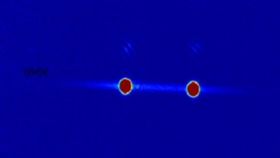


In an attempt to understand how atoms behave and interact at extremely low temperatures, scientists at the University of Otago, New Zealand, developed an optical tweezer system whereby they were able to control the transport of ultracold atoms along a confinement channel.
The scientists used intense laser beams that split a cloud of ultracold rubidium atoms which sequentially resulted in 32 daughter clouds. Unlike the most world’s powerful particle collider, the Large Hadron Collider, which uses extreme acceleration to smash particles together, these experiments used very slow speeds of up to only 1 meter per second. Through the use of steerable horizontal and vertical laser beams, the team were able to not only move and split the atoms from the clouds, but they could collide the atoms, too.
Dr Niels Kajergaard, lead researcher on the project, said in a press release “This sort of precise control of these atoms is like being able to pull a delicate snowflake into two clean halves. It’s quite remarkable that we are able to manipulate such minute and fragile samples while moving them such a comparatively large distance.”
It is hoped that the information gained may shed light on the way that atoms behave at temperatures of less than a millionth of a degree above absolute zero. According to Kajergaard, this could be applied to investigate microscopic structures.