Technology
 PUBLISHED





Unless you are near a star or on a planet, outer space is cold. It can get to just a couple of degrees above absolute zero out there. But the record for the coldest place in the universe isn't out in space. It's right here on Earth.
Every lab working on ultra-cold atoms is on the list of coldest places in the universe. At a handful of degrees above absolute zero, matter behaves in fascinating (and useful) ways. So labs routinely use tech to achieve temperatures that don’t happen naturally.
Temperature is the energy of vibrating molecules and atoms. At absolute zero, or 0 Kelvin (−273.15°C, −459.67°F) nothing moves, as the energy with which the atoms would vibrate has reached its minimum value.
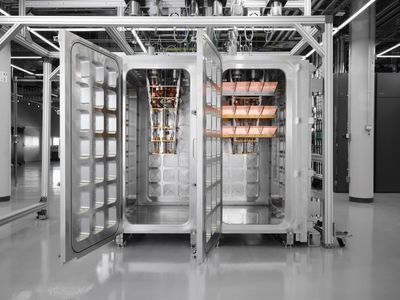
The coldest value ever reached was in a lab in Bremen, Germany, in 2018. It was 38 picoKelvin (38 trillionths of a degree above absolute zero) achieved by the QUANTUS team. Now, IBM has revealed in its site in Yorktown Heights, New York, that they have a quantum refrigerator that can go down to 15 millikelvin.
It's a step on their mission to deliver the world's first fault-tolerant quantum computer by 2029. That’s a quantum computer that can correct itself when errors creep in.
As the quantum computer gets bigger, the likelihood of these kinds of errors increases, so we need a fault-tolerant machine if we want it to be large enough to do calculations that are beyond the capabilities of even the most powerful classical supercomputers.
Getting to really low temperatures is a key step in this process, because low temperatures are less energetic and less "noisy," which is ideal for fragile quantum states and minimizes the risk that they will do unpredictable things that introduce errors.
The first two cryogenic modules of this fridge have now been assembled and joined together. They were first cooled down to 4 degrees Kelvin (the temperature of liquid helium) in under 5 days before the system was cooled further, reaching the exciting millikelvin milestone.
That temperature is several million times hotter than the record from the QUANTUS team, but it is enough to operate the quantum computer as it should. The system is modular so that it can be expanded in the future to accommodate more quantum chips for a more powerful computer.
"Bringing fault-tolerant quantum computers to industries depends on several fundamental advances,” Jay Gambetta, Director of IBM Research and IBM Fellow, said in a statement. “The successful connection and operation of these cryogenic modules signals a leap forward in that direction and will accelerate our progress alongside continued innovation in quantum hardware, software, and algorithms.”
Quantum devices remain of major interest due to their potential to be the next big leap in computing. At the same time, there are major hurdles to resolve. The road to that solution is certainly one that will go through very low temperatures.