Space and Physics
 PUBLISHED




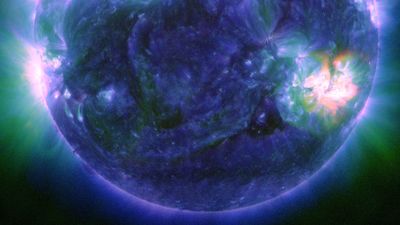


Were you among the lucky people who saw the extraordinary aurorae of May 2024? They were the product of an incredible solar storm, coming from a region on the solar surface that was among the most active of the last two decades. Scientists were keeping an eye on the area before the event and for a while after, marking the longest continuous observation of a solar region yet.
The Sun rotates on its axis roughly every 27 days, so most regions are observed for just the two weeks they are visible from Earth. Since 2020, however, the European mission Solar Orbiter has been orbiting the Sun, and due to its location, there was a period where we could see every bit of our star's surface.
Of particular interest was a region known as NOAA 13664. Observations from Solar Orbiter, combined with NASA’s Solar Dynamics Observatory, provided an unprecedented continuous look at the region over almost 94 days from April 16 to July 18, 2024.
“This is the longest continuous series of images ever created for a single active region: it’s a milestone in solar physics,” said Ioannis Kontogiannis, a solar physicist at ETH Zurich and the Istituto Ricerche Solari "Aldo e Cele Daccò", in a statement.
The observations allowed researchers to study the region from its very formation. They tracked its evolution, the solar storms it produced, its peak, and then its slow, two-month-long decay. While there is a lot we still do not fully understand about active solar regions, the work provides new insights into them and their complex magnetic fields.
“When we see a region on the sun with an extremely complex magnetic field, we can assume that there is a large amount of energy there that will have to be released as solar storms,” said Louise Harra, a professor at ETH Zurich and director of the Physical Meteorological Observatory in Davos, Switzerland.
Solar storms can produce beautiful aurorae, but they are also a serious concern for technology. Satellites are particularly vulnerable due to having less protection from the atmosphere, but railways, phone lines, electrical systems, and computers can all be affected. Even the May 2024 aurorae had some nasty consequences.
“Modern digital agriculture was particularly affected,” explained Professor Harra. “Signals from satellites, drones and sensors were disrupted, causing farmers to lose working days and leading to crop failures with considerable economic losses.”
Charged solar particles even messed with the camera equipment on the Mars rover Curiosity, making it look like the Red Planet was experiencing a snowstorm.
Just when and how an active region of the Sun will produce a solar storm is not known. There could be a series of small eruptions or a single large one, and who knows how strong they will be. Predicting such events would be a revolutionary tool for protecting Earth.
“We’re not there yet. But we’re currently developing a new space probe at ESA called Vigil, which will be dedicated exclusively to improving our understanding of space weather,” added Professor Harra.
Vigil, expected to launch in 2031, was among the missions that got funded at the recent ESA ministerial council, which IFLScience attended.
The study is published in the journal Astronomy & Astrophysics.