Technology
 PUBLISHED
 69
69


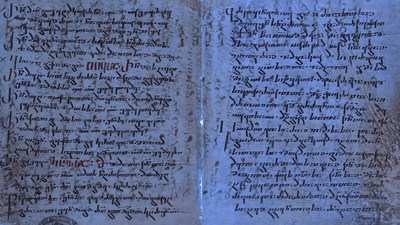


A new chapter of the Bible has been found, hidden inside a 1,750-year-old translation from the Gospel of Matthew. The chapter was found by medievalist Grigory Kessel, who used ultraviolet photography on manuscripts in the Vatican Library.
The hidden text was found as part of the Sinai Palimpsests Project, where researchers aim to recover texts that were erased and written over by scribes in the 4th-12th centuries CE. Palimpsest manuscripts – where earlier text has been washed or scraped off, then reused – were fairly common due to the scarcity of writing materials. However, centuries later text can be recovered by illuminating the manuscripts with fluorescence or different wavelengths of light.
Using these methods, researchers have already deciphered 74 manuscripts, but the latest find was particularly special, containing a translation a century older than the oldest Greek translations, including the Codex Sinaiticus.
"The tradition of Syriac Christianity knows several translations of the Old and New Testaments," Kessel said in a statement. "Until recently, only two manuscripts were known to contain the Old Syriac translation of the gospels."
The translation – first written in the 3rd century CE and copied in the 6th century CE – has not yet been released in full, but offers slightly more detail than the Greek translation of Matthew chapter 12. In verse 1 of the Greek translation, a sentence reads "at that time Jesus went through the grainfields on the Sabbath; and his disciples became hungry and began to pick the heads of grain and eat," while the Syriac translation discovered by Kessel ends "began to pick the heads of grain, rub them in their hands, and eat them".
"Grigory Kessel has made a great discovery thanks to his profound knowledge of old Syriac texts and script characteristics," Claudia Rapp, Director of the Institute for Medieval Research at the Austrian Academy of Sciences added. "This discovery proves how productive and important the interplay between modern digital technologies and basic research can be when dealing with medieval manuscripts."