Humans
 PUBLISHED


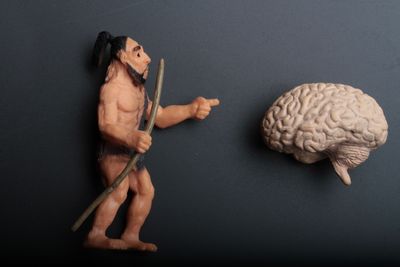


Around 40,000 years ago, our ancient ancestors interbred with Neanderthals, picking up some of their DNA. Since then, much of this genetic material has been purged from our genomes by natural selection, although new research shows that Neanderthal DNA still has an impact on the structure of our brains while also contributing to psychiatric disorders such as schizophrenia and depression.
Neanderthal brains weren’t quite the same as ours, and lacked the globular shape that defines the Homo sapiens noggin. Researchers therefore suspect that many of the genes we inherited from our extinct cousins probably had deleterious effects on our neurological development, and were therefore shed over time.
Despite this, about two percent of the genome of present-day non-African populations continues to be made up of Neanderthal DNA, indicating that not all of this introgressed genetic material was eliminated. To find out how this impacts our brains, researchers analyzed brain scans from around 40,000 people in the UK, linking hundreds of different neurological traits to Neanderthal-derived genetic variants.
Though results have yet to be peer-reviewed, the study authors highlight 28 separate positions within the genome where Neanderthal DNA appears to alter our neurological development. The most significant of these concerns a gene on chromosome 14 called DAAM1, which displays Neanderthal variants that shape 39 different morphological traits within the occipital and parietal cortices.
Neanderthal DNA at this position in the genome also has a protective effect against schizophrenia, indicating how some of the genetic material we picked up during our prehistoric love affair actually benefits our mental health.
On the other hand, Neanderthal variants linked to a gene on chromosome four called PRDM5 seem to contribute to thinning within the frontoparietal cortex, and actually enhance our susceptibility to severe depression, addiction and personality disorders. Another gene called LC13A3, meanwhile, also features Neanderthal variants that may interfere with the structure of our white matter, possibly leading to a condition called leukoencephalopathy and triggering “episodic neurological crises.”
Overall, the study authors say their findings “support a model in which most Neanderthal variants affecting brain morphology were deleterious” to modern humans. However, some of these variants seem to have escaped the purging influence of natural selection, and therefore continue to “shape cortical organization and connectivity in subtle but biologically meaningful ways, with consequences on neuropsychiatric conditions such as schizophrenia and [depression].”
A preprint version of the study is available on bioRxiv.