Space and Physics
 PUBLISHED
 3
3



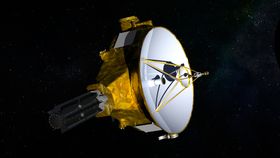


NASA’s New Horizons mission just passed a rare deep-space milestone where it is traveling billions of kilometers away at the edge of the Solar System. On April 17, it crossed the 50 astronomical unit (AU) mark – one AU is the distance between Earth and the Sun – meaning it is now 50 times farther from us than we are from the Sun.
When New Horizons first launched in 2006, it took just minutes to communicate with the spacecraft. Now, it's at a distance of roughly 7.5 billion kilometers (almost 5 billion miles) it takes 7 hours for a message to reach Earth traveling at the speed of light.
“It’s hard to imagine something so far away,” Alice Bowman, the New Horizons mission operations manager at the Johns Hopkins Applied Physics Laboratory, said in a statement. “One thing that makes this distance tangible is how long it takes for us on Earth to confirm that the spacecraft received our instructions. This went from almost instantaneous to now being on the order of 14 hours. It makes the extreme distance real.”
New Horizons becomes the fifth human-made object to reach this far into the cosmos. It follows in the footsteps of the Pioneer 10 and Pioneer 11 probes and Voyager 1 and Voyager 2, all four of which carry plottable maps back to Earth. The latter two have left the Solar System and are now in interstellar space. Voyager 1 is the furthest spacecraft from Earth at about 152 AU, three times farther out than New Horizon.
Last December, New Horizons actually snapped a picture of the field of stars in the direction of where Voyager 1 is. The spacecraft is too small to be visible but there’s never been a chance for spacecraft at the edge of the Solar System to photograph each other like this before.

“That’s a hauntingly beautiful image to me,” said Alan Stern, New Horizons principal investigator from the Southwest Research Institute in Boulder, Colorado.
“Looking back at the flight of New Horizons from Earth to 50 AU almost seems in some way like a dream,” he continued. “Flying a spacecraft across our entire Solar System to explore Pluto and the Kuiper Belt had never been done before New Horizons. Most of us on the team have been a part of this mission since it was just an idea, and during that time our kids have grown up, and our parents, and we ourselves, have grown older. But most importantly, we made many scientific discoveries, inspired countless STEM careers, and even made a little history.”