


 Space and Physics
 PUBLISHED


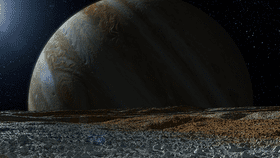


A new NASA study has confirmed that water vapor is present above Europa, one of Jupiter's 79 moons, suggesting that below the ice there may be liquid water – a necessary ingredient for life.
Europa (along with Enceladus) may be the best candidate for life in the Solar System. Below the surface of Jupiter's sixth-closest moon, there might be a liquid ocean that could potentially host life. This year, signatures of salt were found, indicating the ocean floor may be hydrothermally active, which could lead to complex chemistry and heat – again making life more likely.
Now, a team led by NASA’s Goddard Space Flight Center in Greenbelt, Maryland, has confirmed the presence of water vapor above Europa’s surface for the first time. This was achieved by observing the sixth-largest moon in the Solar System through one of the world's largest telescopes in Hawaii. Their findings are reported in Nature Astronomy.
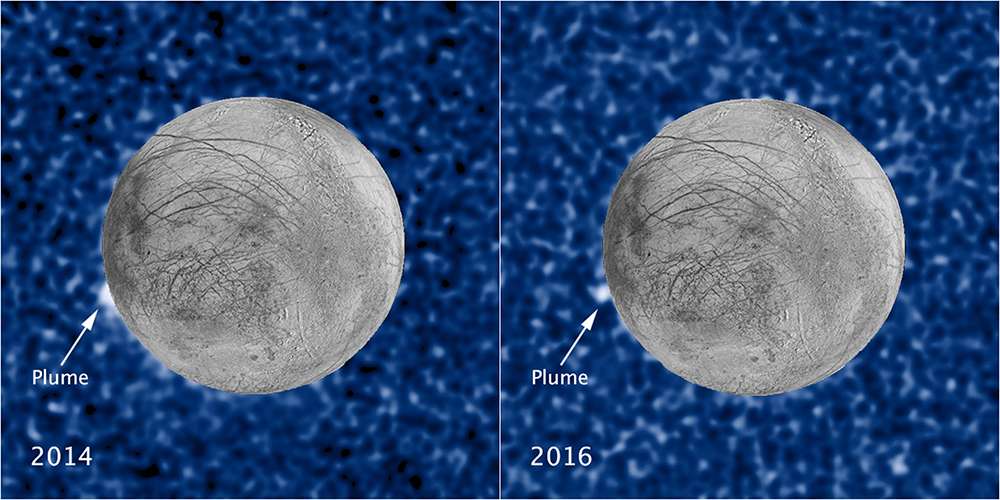
Plumes have been spotted before on the moon, and it's even possible that craft Galileo flew through one in 1997. However, it wasn't known for sure what the plumes were made of until the W. M. Keck Observatory in Hawaii used a spectrograph to detect the chemical composition. And boy did they find what they were looking for.
"They detected enough water releasing from Europa (5,202 pounds, or 2,360 kilograms, per second) to fill an Olympic-size swimming pool within minutes," NASA said in a statement.
This is great news for fans of (potential) life, though the team notes that of the telescope's 17 observations, water was only found once. This suggests that "outgassing of water vapor on Europa occurs at lower levels than previously estimated, with only rare localized events of stronger activity."
“Essential chemical elements (carbon, hydrogen, oxygen, nitrogen, phosphorus, and sulfur) and sources of energy, two of three requirements for life, are found all over the Solar System," NASA planetary scientist and leader of the investigation Lucas Paganini said.
“While scientists have not yet detected liquid water directly, we’ve found the next best thing: water in vapor form.”
“We performed diligent safety checks to remove possible contaminants in ground-based observations,” Avi Mandell, a Goddard planetary scientist on Paganini’s team, added. “But, eventually, we’ll have to get closer to Europa to see what’s really going on.”
Fortunately, we might not have to wait too much longer in order to get a closer look. The Europa Clipper mission – expected to launch in the mid-2020s – will see an orbiter conduct a detailed survey of Europa's surface, subsurface ocean, and smaller active vents, armed with spectrometers of its own. It will even seek out potential sites for a future Europa lander.



 1
1