Humans
 PUBLISHED
 2
2


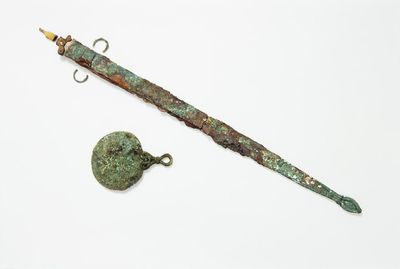


Some time in the first half of the first century BCE, a mystery individual was buried on a small island off the coast of England along with a unique array of grave goods. It took until 1999 for the body to be discovered, yet the presence of both a sword and a mirror – items typically associated with male and female graves respectively – left researchers bamboozled as to the gender and identity of the interred.
Unfortunately, the skeleton itself is highly degraded, making it impossible to tell if the deceased was a man or a woman. However, revisiting the ancient burial site on the Isles of Scilly, researchers have now managed to determine that the grave’s occupant was indeed female, based on an analysis of the surviving dental enamel.
Having cleared up that mystery, the researchers are now grappling with the conundrum posed by the grave goods. Not only is the burial the most richly furnished in the region, but the combination of martial items – including a sword and shield – and a mirror has not been seen in any other Iron Age grave in Western Europe.
Addressing the weaponry, the study authors begin by examining “the simplest interpretation, [which is] that these were placed in the grave to symbolise that she took part in warfare, perhaps wielding these very weapons or ones much like them.”
“In a small, island community, it would clearly be advantageous if all able-bodied individuals could contribute to the defence of their settlement by force of arms should it come under attack,” write the researchers. “Under such circumstances, the ability to accomplish martial deeds may have been valued in both sexes.”
On the face of things, this would seem to explain why an Iron Age woman was buried with a sword and shield. However, as the study authors point out, no other Scilly women have been found with similar grave items, raising the question of why this particular individual was singled out for special treatment.
“This becomes more readily understandable if she had a prominent role in undertaking raids on other communities or a leadership role in organising raids, as well as participating defensively,” speculate the researchers. Admitting that their theory is somewhat conjectural, they say that the “deposition [of weapons] in her grave may also have meant that she was intended to continue to play a martial or protective role after her death, acting as a supernatural guardian for her community.”
Turning their attention to the bronze mirror, the study authors note that the item could have been used for heliographic signalling, which refers to the use of flashing light as a form of communication. “This might have been of value for an island community for communicating with neighbouring islands and with craft at sea,” they write.
Taking this theory further, they explain that the ancient woman may have used the mirror to plan and coordinate raids on other communities or the defence of her own village.
“Our findings offer an exciting opportunity to re-interpret this important burial. They provide evidence of a leading role for a woman in warfare on Iron Age Scilly,” explained study author Dr Sarah Stark in a statement.
“This could suggest that female involvement in raiding and other types of violence was more common in Iron Age society than we’ve previously thought, and it could have laid the foundations from which leaders like Boudicca would later emerge.”
The study is published in The Journal of Archaeological Science: Reports.