Space and Physics
 PUBLISHED
 3
3



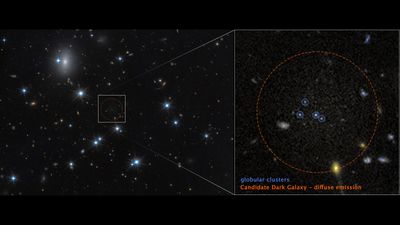


Astronomers report the discovery of a truly incredible object. They are calling it Candidate Dark Galaxy-2 (CDG-2), a somewhat humdrum name for something truly incredible, a galaxy made almost completely of dark matter.
The rest of this article is behind a paywall. Please sign in or subscribe to access the full content.But how does one discover an object that, by and large, doesn’t emit light? By tracking the parts that do, that's how. Astronomers used globular clusters, spherical systems of hundreds of thousands to millions of stars that orbit the halos of dark matter around galaxies.
Using the Hubble telescope, the team was able to find four globular clusters in the Perseus Cluster whose motions appear to suggest the presence of a galaxy. The galaxy itself is nowhere to be seen, but the researchers estimate its halo mass could be between 20 billion and 120 billion times the mass of the Sun, while the total stellar population could be just 12 million solar masses. At the upper end of the halo mass, this would mean the galaxy's stars account for just 0.01 per cent of its total mass.
“This is the first galaxy detected solely through its globular cluster population,” lead author David Li, from the University of Toronto, said in a statement. “Under conservative assumptions, the four clusters represent the entire globular cluster population of CDG-2.”
The team followed up on these four objects, located 300 million light-years away, not just with Hubble but also with the European Space Agency’s dark universe telescope Euclid, and with the National Astronomical Observatory of Japan’s Subaru Telescope. If this extreme galaxy is confirmed, it could provide important insights into how galaxies form inside a halo made almost exclusively from dark matter.
“The Euclid data clearly confirm the presence of the extremely faint, diffuse light of CDG-2, revealing the galaxy behind the globular clusters for the first time,” added Francine Marleau from the Institute for Astro- and Particle Physics at the University of Innsbruck in Austria.
“The Euclid images of the Perseus cluster demonstrate the mission’s unique capability to detect new low-surface-brightness galaxies, including extremely faint ones, while also revealing their globular clusters, nuclear star clusters, internal structures, and surrounding environments.”
The reason for the darkness of this galaxy might be found in the interactions within the packed Perseus cluster. The presence of other objects might have stripped this CDG-2 of much of its gas, leaving it with an extreme star-to-dark-matter ratio.
The science paper detailing this finding was published in The Astrophysical Journal Letters.