Technology
 PUBLISHED


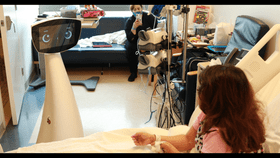


A robot has been roaming the halls of UCLA Mattel Children’s Hospital, visiting sick children and brightening up their outlook in a heart-warming new study. Researchers discovered that their human-controlled robot, called Robin, was able to encourage a more positive outlook in the children and even improve their medical interactions, and outlined their important work in a study that will be presented at the American Academy of Pediatrics (AAP) National Conference.
“Our team has demonstrated that a social companion robot can go beyond video chats on a tablet to give us a more imaginative and profound way to make the hospital less stressful,” said Justin Wagner, MD, a pediatric surgeon at UCLA Mattel Children’s Hospital and senior author of the study, in a statement.
“As the pandemic continues, our patients are still feeling anxious and vulnerable in a variety of ways, so it’s critical that we be as creative as possible to make their experiences easier when they need our help.”
Robin is around 1.2 meters (4 feet) tall and can move, talk and play with the children, and features a screen on the top that can show facial expressions and more. Robin visited the children for hour-long sessions during the study period, and the outcomes were compared to that of using a standard tablet, which have become commonplace in hospitals while the pandemic continues.
They discovered that 90 percent of patients were "extremely likely" to ask for another visit from Robin, indicating an overwhelmingly positive response to the robot friend. Alongside this, there was a reported 29 percent increase in positive affect (how positively the children reacted to the world), which was significantly more promising than the tablet visits, and a 33 percent decrease in negative affect.
The mood improvements even seemed to affect the healthcare workers and families, suggesting Robin was a significantly better option compared to current ways of remote visiting.


 2
2