Space and Physics
 PUBLISHED



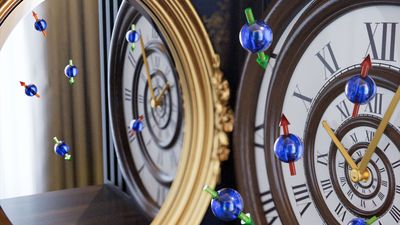


Most of the directions we use to describe the world center the self. We say up or down, in front or behind us, and left and right. These latter two are the most difficult to explain in fundamental terms given the symmetry of most physical laws. But in nature, there are molecules that have a distinct “handedness” or chirality; they are not the mirror image of each other. They can’t be superimposed.
Chirality is usually measured with chemical methods, but a research team has shown that it might be possible to measure such a property with magnetism. Their results suggest that chiral molecules and crystals possess “spin-selectivity” – they can separate electrons into two groups depending on whether their spins are pointing in one direction or the opposite. The reason why this is the case is yet to be confirmed. But bringing in magnetism could be a game changer.
“To test the hypothesis, you must map electron spins in a single chiral molecule. A big difficulty is that chiral molecules are so small that you cannot do so,” team leader Professor Hiroshi Yamamoto, from the Institute for Molecular Science, said in a statement. “Instead, we took up an organic chiral superconductor as a giant chiral molecule.”
Superconductors are materials through which electrons flow with no resistance. All the electrons become correlated and, according to this work, they appear to separate each other in terms of spin. Even by rotating the molecule this separation remains unaltered, and could be used to understand the chirality of the crystal in question.
“The observed spin distribution is relevant to chiral recognition,” elaborates co-author Assistant Professor Daichi Hirobe. "Depending on the handedness, two spin polarizations sit face-to-face or back-to-back at both edges of a superconductor. This unique configuration has been hypothesized for chiral molecules, but it has not been verified."
Chiral molecules are not just common, they are fundamental. All known life forms use specific chiral properties in their chemical structures, and once an opposite is encountered weird stuff can happen. Take for example the molecule known as limonene, present in the peel of oranges and lemons (among other plants). In those two fruits, the molecules are of the opposite chirality, and give us two very different smells.
But there is more. Spintronics is a branch of electronics that aims to use the spin and charge of electrons for digital information, moving beyond standard electronics where the charge is the only element that matters. This work shows that the researchers' chiral superconductor can create a spin-dependent voltage that is 1,000 larger than expected. This could have exciting applications in this young technological field.
The study is published in the journal Nature.


 1
1