Space and Physics
 PUBLISHED
 3
3



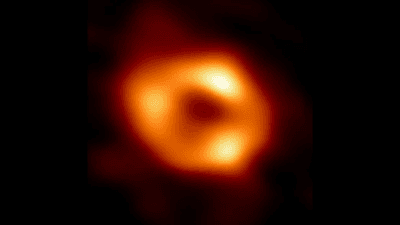


If we had powerful enough telescopes in the 1820s, looking toward the center of the galaxy, we would have seen a bright flare. Sagittarius A* (Sgr A*), the supermassive black hole at the core of the Milky Way, launched its last known flare about 200 years ago, and we know that happened because an x-ray echo was left behind and astronomers have spotted it.
Looking at the giant molecular clouds that surround the supermassive black hole has been thought of as a good method to track flares from Sagittarius A*. The X-rays from these sources are just a reflection of the brightness of the flare itself. It was very bright, roughly the amount of energy released by the Sun in 820,000 years, and Sagittarius A* was able to deliver that in just one year. The research team compared this sudden increase of luminosity to a glowworm suddenly becoming as bright as the Sun.
“Reflection of X-rays from Sgr A* by dense gas in the Galactic Centre region offers a means to study its past flaring activity on timescales of hundreds and thousands of years,” the researchers wrote in the paper. “The shape of the X-ray continuum and the strong fluorescent iron line observed from giant molecular clouds in the vicinity of Sgr A* is consistent with the reflection scenario. If this interpretation is correct, the reflected continuum emission should be polarized.”
Light is polarized when it is forced to oscillate in a specific plane perpendicular to its direction of movement. That’s how polarized lenses work: by only being transparent to light oscillating on certain planes, they block a lot of it out. In space, this can be used to test a lot of things, such as the X-ray echo from a flare scenario. And they indeed see this polarization.
The polarization is also important because it tells scientists the specific angle of the polarized light. That acts like a compass pointing right at the source of this polarized light. It is not that surprising to find that the angle points towards Sagittarius A*.
The X-ray signals were observed using NASA’s IXPE (Imaging X-ray Polarimetry Explorer) and NASA’s Chandra X-ray space telescope, and the observations were then sonified, turning the luminosity of the source and the echo into an audio spectrum that we can hear.
The supermassive black hole is 26,000 light-years from Earth and its flaring did not affect our planet at all. There is a peculiar object around Sagittarius A* called X7 that might become food for our quiet supermassive black hole within the next 15 years. Then, we might actually see a flare happening live… well 26,000 years after it actually happened, but still live for us. Silly finiteness of the speed of light!
The research is published in the journal Nature.