Technology
 PUBLISHED
 1
1


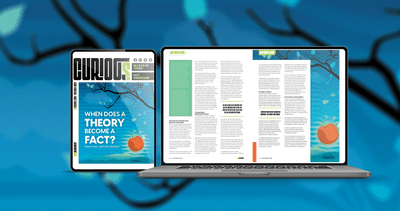
IFLScience’s e-magazine CURIOUS Issue 3 is out now, bringing you more science highlights for the month ahead plus deep dives into intriguing topics, diary dates for events not to miss, and explanations for some of Earth’s most perplexing natural phenomena and landscapes.
CURIOUS is the perfect read if you’re after a more relaxed form of scientific exploration to savor at your leisure. Best of all, you can even download a PDF for offline reading, so you can always have the latest issue to hand to spice up that daily commute.
Join us as we put curious questions to top experts, share excerpts from the latest science books, and tackle some of the most challenging topics across science. Are you CURIOUS? Find out what to expect from issue 3 below.
Read Issue 3 of our digital magazine now by clicking below! Use the arrows to navigate or download the PDF for easy access.
In This Issue…
OUR COVER STORY: When Does A Theory Become A Fact?
Does it ever, and who decides? We explore this thorny question, revealing the stark contrasts between the very meaning of each word in science and common parlance, and why those differences matter. Read more
DEEP DIVE: Can AI Help Us Talk To Animals?
Dr Doolittle may have walked (and talked) with the animals so that AI could run. We dive into the emerging science of humans trying to speak to animals using technology. As scientists are getting to grips with translating the clicks and whistles of cetaceans, could a phone call with a monkey soon be on the cards? Read more
WE HAVE QUESTIONS: How Can Cryoconservation Save Earth's Species From Extinction?
Cryoconservation, or cryopreservation, is a new and exciting branch of science that aims to create living biobanks of tissues taken from rare and endangered species. In this interview, we spoke with the cofounders of Nature’s SAFE to find out how the process works, and how it can safeguard species for the future. Read more
WHERE ON EARTH: A Record-Breaking Number Of Hoodoos Can Be Found In Bryce Canyon
Wandering among the hoodoos of Bryce Canyon you may feel like you’re walking on the surface of an alien planet, but these bizarre rock formations are actually the result of natural forces. Appreciate them while you can, scientists fear the changing climate may one day rid them of their character. Read more
Exclusive: Meet author Kristy Hamilton and read an excerpt from her new book Nature’s Wild Ideas.
Plus: News, diary dates, what to see, watch, and read this month, and much more.