Space and Physics
 PUBLISHED
 3
3



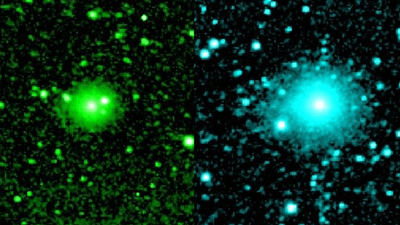


Interstellar comet 3I/ATLAS is soon to have a potentially course-altering encounter, before it heads out of our Solar System for good in the direction of the Gemini constellation.
Last year, the Solar System received its third confirmed interstellar object, in the form of interstellar comet 3I/ATLAS. This comet has traversed the galaxy for billions of years, and is likely older than the Solar System it is currently passing through.
The object has already had its closest encounters with Mars, Earth, and the Sun. The encounter with the Sun saw 3I/ATLAS change dramatically, with a massive release of organic molecules, while the approaches to Earth and Mars weren't close enough to have a large effect on the comet.
But before our interstellar visitor leaves us for good, it has one last close encounter to go, and it's possible it might be a course-altering close shave. On March 16, the object's path will take it close to our largest gas giant. On that day, it will pass within 0.35832 astronomical units (AU) of Jupiter, with one AU being the average distance between Earth and the Sun.
Why is that significant? It is incredibly close to Jupiter's "Hill radius" or "Hill sphere". This is the region around a massive body where its gravity dominates over more distant objects like the Sun. Jupiter's Hill radius is around 0.355 AU, or around 53 million kilometers (33 million miles).
"The comet 3I will definitely suffer the perturbation from both Mars and Jupiter at their respective close approach epochs," the authors of one preprint study (a paper that has yet to be peer-reviewed), which used dynamic simulations to map 3I/ATLAS's path, explained ahead of the close encounter with Mars.
"The effect of Jupiter will be larger due to the fact that the comet is passing very close to the Hill radius of Jupiter," the team wrote.
Whether this encounter will significantly affect the course of 3I/ATLAS, however, depends on the non-gravitational acceleration of the object. Though this sounds kind of spaceshippy, all it means is the acceleration that isn't due to gravitational interactions alone, but factors such as outgassing and radiation pressure from the Sun.
"We find that the major effects on comet 3I’s orbit are seen when the nongravitational acceleration is of the order of 10−5 to 10−6 auday−2," the authors explained. "The non-gravitational acceleration of 10−7 auday−2 and lower has negligible effect on the various parameters."
Mapping the comet's path back and forward over longer timescales, the team found that it likely came from the direction of the Sagittarius constellation, and it will depart in the direction of Gemini. Before that, we will have another opportunity to study the object as it approaches Jupiter. So long, very old friend.
The study is posted to preprint server arXiv.